
How to Search Maricopa County Warrants
The main public tool is the MCSO warrant lookup. The portal sits on the Sheriff's Office site and pulls from the live MCSO warrant file. A user can search by first name, last name, agency, city, or zip. The page returns a short results table with the date of warrant and a More Details button for each match. The portal is open to anyone with a browser and no account is required.
Superior Court warrants need a phone call. The Superior Court warrant information page tells the public to contact the Criminal Department to find out if a person has a Superior Court warrant in Maricopa County. The Criminal Department Information Desk number is 602-506-8575. A probation violation warrant is checked through the Probation Violation court line at 602-372-0427.
A name match at MCSO is a starting point. Real proof of identity is set by fingerprints, not by a name hit. Bring a date of birth or full middle name to cut down on false hits when the surname is common.
- Open the MCSO warrant lookup page in any browser.
- Type a last name in the Last Name field. Add a first name to narrow the result list.
- Pick an agency from the Agency dropdown if the warrant tie-in is known. Leave blank to search all agencies.
- Add a city or zip if the person's address is known. Click Search.
- Scan the results table for the right person and click More Details to see the full warrant record.
- For a Superior Court warrant not on MCSO, call the Criminal Department at 602-506-8575 with the person's full name and date of birth.
Note: A warrant stays in effect until the person is arrested or the issuing court quashes it, so old MCSO hits should be checked by phone before any action is taken.
Types of Warrants in Maricopa County
The Superior Court warrant page lists two main categories: bench warrants and arrest warrants. A bench warrant is set when a defendant does not show up for a hearing. A failure to appear gives the judge the green light to sign the warrant. The same path is used for probation violation warrants when the person breaks probation terms. Arrest warrants are signed when there is probable cause that a person has broken the law and the court orders law enforcement to bring them in.
Search warrants are a third type. A search warrant lets officers enter a home, car, phone, or other place to look for evidence. They are not on the public warrant lookup. They are held in the court file and may be sealed until the case is filed. A capias is close to a bench warrant in Arizona practice and may show up when a witness fails to appear or when the court needs to bring a party in to answer for contempt.
- Bench warrant. Issued when a defendant skips a court date. Often tied to a misdemeanor or felony case already on file in Superior Court or Justice Court.
- Arrest warrant. Signed on probable cause from a new criminal complaint. Stays in effect until the person is arrested or the court quashes it.
- Probation violation warrant. A bench warrant tied to a probation case. Handled by the Probation Violation court at 602-372-0427.
- Search warrant. Authorizes a search of a person, home, vehicle, or device. Not on the public lookup.
- Capias / failure to appear. Used to compel a witness or party to come back to court. Less common than the bench warrant but used in civil and criminal files.
What Appears in a Maricopa County Warrant Record
The MCSO portal exposes a full warrant detail template. When a result is clicked, the More Details button opens a panel with the person's basic descriptors, the warrant ID, the offense, and the issuing court. Bond data, where it exists, is shown as part of the same detail card. The Superior Court warrant page notes that the public warrant list is meant to help locate people, not to substitute for the court file itself.
The MCSO Most Wanted page is run by the Fugitive Apprehension Tactical Enforcement Unit, or FATE. FATE is a member of the FBI Desert Hawk Violent Crimes Task Force. The Most Wanted list flags violent fugitives wanted on arrest warrants or probable cause. Tips on the Most Wanted list route to Silent Witness at 480-WITNESS (948-6377) or 480-TESTIGO (837-8446) and not back through MCSO.
A search of the Superior Court warrant information page shows the court self-surrender path and the contact lines for the Criminal Department.
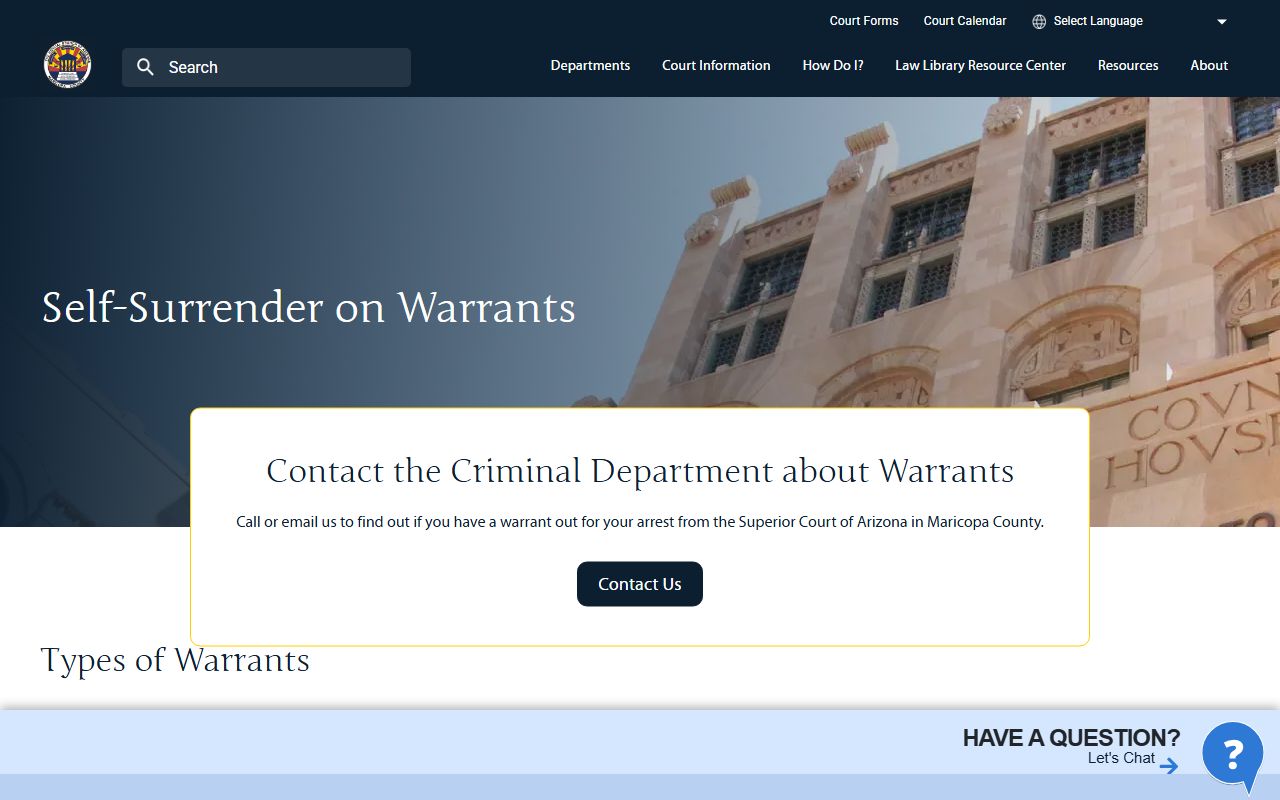
The Superior Court page also makes clear that an arrest warrant in Arizona stays in effect indefinitely. Only the issuing court can quash, cancel, or resolve the warrant.
Maricopa County Warrant Search Fields
The MCSO warrant lookup has a small set of public search fields. None are strict required fields, but the search runs best with at least a last name. The full field set, pulled from a live inspection of the portal, is shown below.
| Field Label | Type | Required | Options / Format Notes |
|---|---|---|---|
| First Name | text | optional | Public search field. |
| Last Name | text | optional | Public search field. |
| Agency | dropdown | optional | Dropdown of law enforcement agencies; options not shown in static snippet. |
| City | text | optional | Public search field. |
| Zip | text | optional | Public search field. |
| Search | button | n/a | Runs the warrant search. |
| Show entries | dropdown | optional | Sets results pagination size. |
| Keyword Search | text | optional | In-table keyword filter for results. |
| More Details | button | n/a | Opens warrant detail panel. |
| Send Tip | button | n/a | Opens the tip submission form. |
| Narrative: Offense Location | text | optional | Tip form field for last-known location. |
| Name | text | optional | Tipster name on tip form. |
| text | optional | Tipster email on tip form. | |
| Phone Number | text | optional | Tipster phone on tip form. |
| Submit | button | n/a | Sends the tip to MCSO. |
The results table itself is narrow. It shows First Name, Last Name, Date of Warrant, and a More Details button. The full warrant data lives in the detail panel that opens from that button.
Sample Warrant Record Fields
Once More Details is clicked, the MCSO template exposes a fuller record. The field list below is the public detail set pulled from the MCSO warrant page template. It is the same set the portal builds for every active warrant on the list.
| Field | What It Shows |
|---|---|
| Warrant Name | Full legal name of the subject as listed on the warrant. |
| Warrant ID | MCSO internal warrant identifier. |
| Warrant Number | Court-issued warrant number tied to the case file. |
| DOW / Date of Warrant | Date the warrant was signed by the judge. |
| Offense | Short offense code or label. |
| Offense Description | Plain-language description of the charge. |
| Original Offense | Underlying offense if the warrant came from a probation or bench scenario. |
| Bond | Bond amount set on the warrant, if any. |
| Court Name | Issuing court (Superior Court, Justice Court, City Court). |
| Agency Name | Law enforcement agency holding the warrant. |
| OTY | Offense type or warrant type code used by MCSO. |
| Address / completeAddress | Last known address on file. |
| Sex | Reported sex of the subject. |
| DOB | Date of birth of the subject. |
| Height | Reported height. |
| Weight | Reported weight. |
| Hair Color | Reported hair color. |
| Eye Color | Reported eye color. |
| Race | Reported race code. |
These fields help confirm the right person. A bond figure can also help plan for a self-surrender, since some Justice Court bonds can be posted at the jail at the time of booking.
What to Do If You Have an Outstanding Warrant
The Superior Court of Arizona in Maricopa County lays out a clear path for anyone who finds an open warrant in their name. The first step is legal advice. The next step is contact with the issuing court. The third step is a planned self-surrender at MCSO when the court orders it. The plan below tracks the official Superior Court warrant page guidance.
- Get a lawyer first. The Superior Court page says to seek legal representation as soon as the warrant is found. A lawyer can confirm the facts of the warrant and may file a motion to quash before any arrest.
- Confirm the warrant. If no attorney is on board, call the court that issued the warrant. A Superior Court warrant goes through the Criminal Department Information Desk at 602-506-8575. A probation violation warrant goes through 602-372-0427.
- Pull the case file. Use the public case lookup to read the docket and the charging document. A clear picture of the case helps the lawyer draft a motion to quash or set a bond.
- File a motion to quash. A motion to quash asks the judge to lift the warrant and set a new court date. The motion is filed with the issuing court. If the warrant is held by another state, contact that state's court; an arrest in Arizona can lead to extradition.
- Plan the self-surrender. When the court orders self-surrender to serve a sentence, the order says to report to MCSO with the proper paperwork. The Custody Bureau processes self-surrenders through Intake, Transfer and Release at 2670 S 28th Drive in Phoenix.
- Bring ID and paperwork. Bring a valid photo ID, the court order, and any sentencing minute entry. Funds for the inmate account can be deposited later through TouchPay.
- Arrange release of property and rides. Plan for a ride away from MCSO if released after booking, or for someone to take car keys and a phone home if booking leads to a hold.
A person no longer in Arizona should still get a lawyer. The Superior Court page notes that out-of-state contact does not lift the warrant. The case can be addressed by phone and by motion, but only the issuing court can sign off on the quash. More on the booking flow and the five MCSO detention facilities is on the Maricopa County inmate records page.
Important: Talk to a defense attorney before turning yourself in, since timing, bond posture, and a motion to quash can change whether the surrender ends in release or in a hold.
The Sheriff's Office front page sets out the booking arms of the agency and the way arrests, court remands, and self-surrenders are funneled into Intake.
That same Sheriff's Office portal is the source of the MCSO warrant lookup link and the public-facing tip line for Most Wanted fugitives. See the full agency site at mcso.org.
Crime Stoppers and Silent Witness Tips
Silent Witness is the local anonymous tip line for warrants and serious crimes in Maricopa County. The MCSO Most Wanted page directs tipsters to Silent Witness at 480-WITNESS (948-6377) in English or 480-TESTIGO (837-8446) in Spanish. Tipsters do not have to give a name. Cash rewards can be paid out for tips that lead to an arrest.
The MCSO warrant lookup itself has a built-in Send Tip button. The tip form takes a tipster name, email, phone, and a narrative field for the offense location. The data is routed to MCSO for review. A tip on the MCSO Send Tip form is not the same as a Silent Witness tip and does not carry the Silent Witness reward.
The MCSO inmate search lookup is on the same agency site and is often used together with the warrant lookup when a person has just been booked.
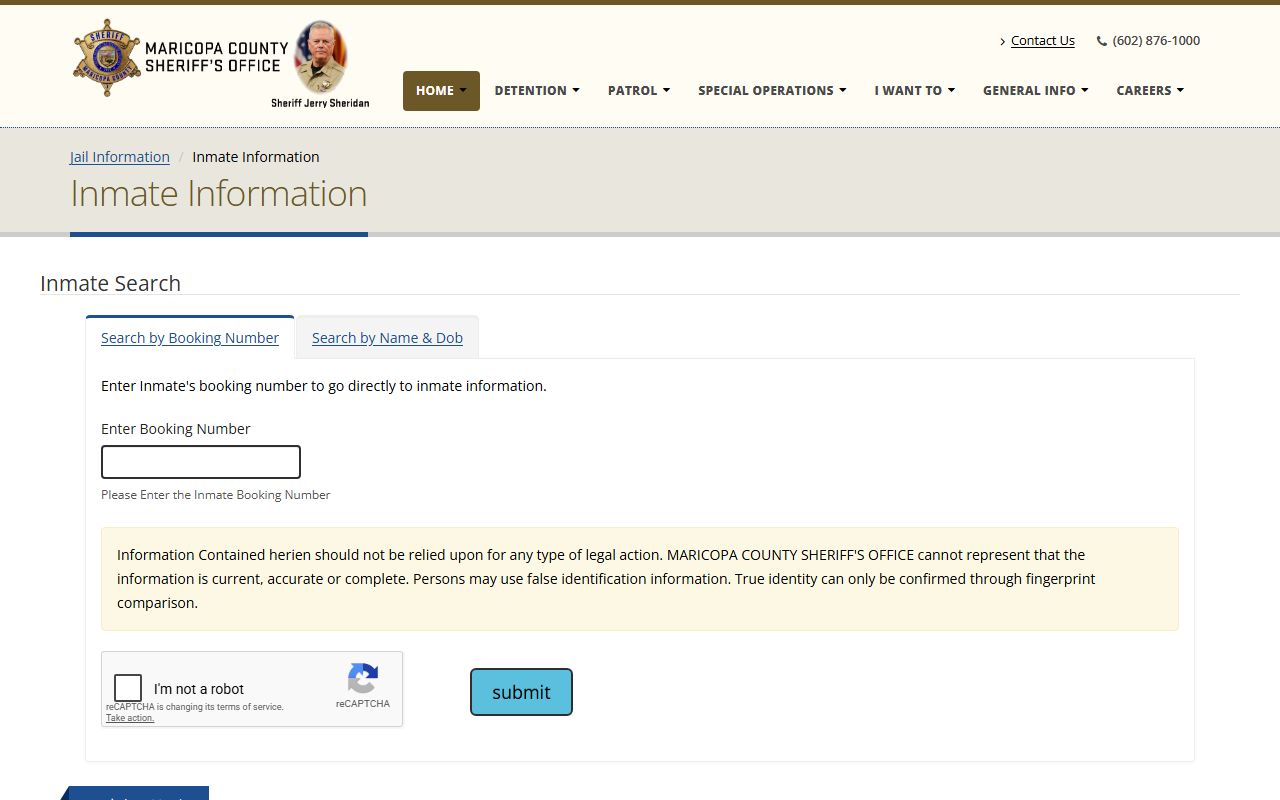
The MCSO inmate information page takes a booking number or a last name, first name, and date of birth, and shows whether the person is now in custody at one of the five MCSO jails.
Superior Court Criminal Department Contact
The Criminal Department is the single best point of contact for any warrant signed by a Superior Court judge in Maricopa County. The department also handles probation violation warrants through a separate phone line.
Note: Call before walking in, since the Criminal Department can confirm by phone whether a warrant exists and which court date or judge is tied to it.
Maricopa County Superior Court — Criminal Department
Central Court Building
201 W Jefferson St
Phoenix, AZ 85003
Criminal Department Information Desk: 602-506-8575
Probation Violation Court: 602-372-0427
Customer Service Center: 602-506-3204
Self-surrender drops happen at MCSO Intake, Transfer and Release at 2670 S 28th Drive, Phoenix, AZ 85009. The Sheriff's Office main line is 602-876-1000. The mailing address for the Sheriff's Office is 550 West Jackson, Phoenix, Arizona 85003.
Restrictions on Maricopa County Warrant Info
Not every warrant is open to the public. The MCSO warrant lookup shows active local warrants tied to the agencies that file with MCSO. Sealed warrants, juvenile warrants, and some pending warrants are held back. The Superior Court page makes clear that warrant info from the court itself must come through the Criminal Department, not from the online docket alone.
Search warrants are filed under the case but are often sealed at the time of issue. They open up later, when the case is charged or when the court rules the seal is no longer needed. Federal warrants are not on MCSO at all. A federal warrant goes through the U.S. Marshals Service and the federal court that signed it.
Out-of-state warrants are a separate path. The Superior Court page tells the public that an out-of-state warrant means contact with that state's court is needed. An arrest in Arizona on an out-of-state warrant can lead to extradition. A person should not rely on the MCSO lookup alone to confirm that no warrant exists in another state.
A name hit is not a positive ID. The MCSO disclaimers say the public should not rely on the lookup for any legal action. True identity is only confirmed by fingerprints. People can give false names at arrest, so the public list can carry the wrong subject's data until the records are corrected.