
Arizona Public Records Law Overview
Arizona's open-records framework lives in Title 39 of the state statutes. The core rule is A.R.S. § 39-121, which says public records and other matters in the custody of an officer are open to inspection by any person during office hours. The law applies broadly to government records held by state and county bodies. It also applies to records kept by the Clerk of the Superior Court when those records are not court case files. Anyone may ask. Reason is not required for most requests.
The companion statute, A.R.S. § 39-121.01, defines who counts as an officer and what counts as a public body in Maricopa County. It also lays out the duty to keep records, the right to ask for copies or printouts, the option of examination by mail, and the index rule. The same section requires the requester to state whether the use is commercial or noncommercial. Records officers can charge a fair fee for copies. Inspection at the office is free.
Below the state-level rules sit the local routes. Maricopa County departments handle their own public-records intake. The Clerk of the Superior Court has a dedicated online request form for case files and recorded marriage records. The Sheriff's Office takes requests through MCSO Records. Each Justice Court precinct keeps its own files. State guidance from the Arizona State Library is published through the Arizona State Library public records branch for context on records management duties.
The screenshot below shows the live text of A.R.S. § 39-121 on the state legislature site. Source: azleg.gov A.R.S. § 39-121.
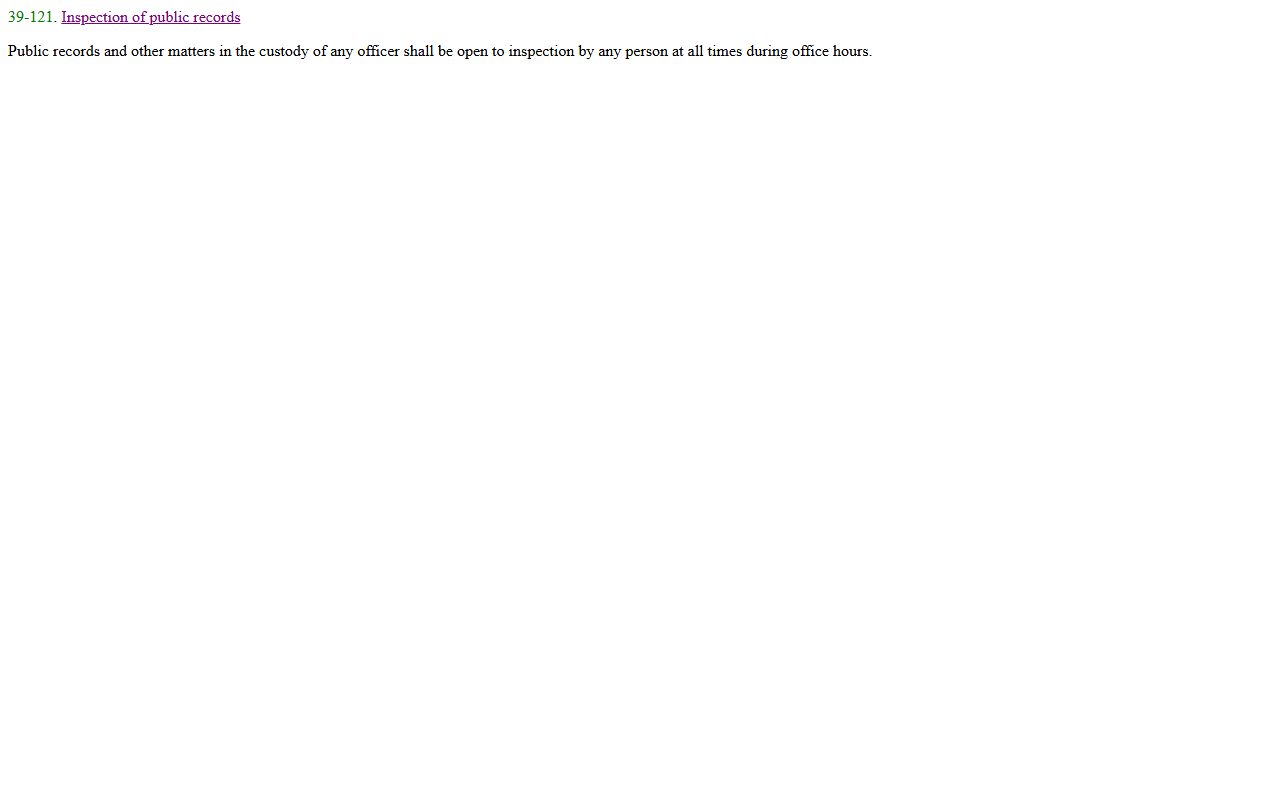
The statute text confirms that any person may inspect public records during office hours, which is the legal floor Maricopa County offices must meet. The Arizona Ombudsman Citizens' Aide also publishes interpretive guidance for tough cases.
Note: Court case files held by the Clerk of the Superior Court follow Rule 123, not the Title 39 form route used for general county records.
What Records Are Public in Maricopa County
Maricopa County keeps many record types open to the public. Most case dockets are public. Most county business and policy files are public. Some files are closed by law. Mental-health, juvenile dependency, adoption, and sealed files are not open. The list below covers the main public categories you can request from county offices and courts.
- Superior Court case files: civil, criminal, family, probate, and tax dockets and most filings, held by the Clerk of the Superior Court.
- Justice Court files: small claims, eviction, civil traffic, misdemeanor, and protective order files at the 26 precincts.
- Marriage license records: issued and stored by the Clerk of the Superior Court, with certified copies for a fee.
- County deeds and recorded documents: kept by the Maricopa County Recorder, not by the Clerk.
- Sheriff jail roster, booking logs, and active warrants: kept by MCSO.
- County budget, contracts, board minutes, and policy memos: kept by the relevant department.
- Civil court sample fields include case number, judge, file date, location, party names, party roles, attorney, and docket descriptions.
Each office sets its own intake path. The Clerk uses an Online Records Request Form. The Sheriff uses MCSO Records. The Justice Courts route requests through court administration when the file does not show up in the public portal.
How to File a Public Records Request
The right path depends on the record type. Court files go to the court that heard the case. General county records go to the office that owns the data. The five steps below cover the standard route used by most filers in Maricopa County.
- Find the right office. Court case file goes to the Clerk of the Superior Court or to the Justice Court precinct. Jail or warrant file goes to MCSO. Deed goes to the County Recorder. Charging policy goes to the County Attorney.
- Describe the record in plain words. Give the case number, date range, names, and document type. A vague request slows the response. Be exact.
- Submit the request. Use the Online Records Request Form for Clerk files. Mail or email for other offices. Walk-in is also fine at the Clerk's public counters from 8:00 AM to 5:00 PM, Monday through Friday.
- State your purpose. A.R.S. § 39-121.03 makes you state whether the use is commercial. Most personal use is noncommercial. Mark the right box.
- Pay fees and pick up the file. The office will send a fee total. Pay by money order, debit, credit, or cash at the counter. Personal checks are not taken at the Clerk.
The Justice Court records request page sets out its own intake and fee notes. Source: Maricopa County Justice Courts request records page.
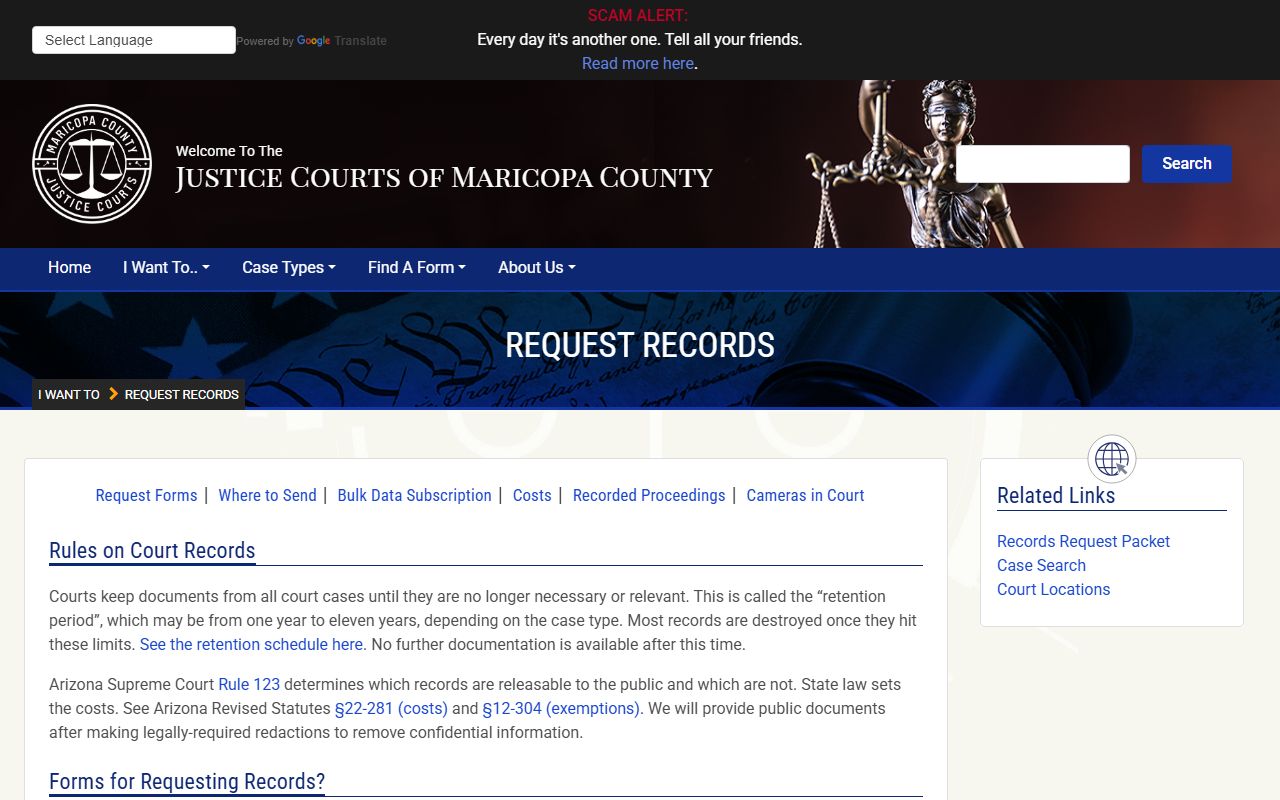
The Justice Court page lists the request flow and tells filers to identify the precinct that held the case before sending the form.
Request Form Fields
The Clerk's Online Records Request Form asks for the data the office needs to find the file and to bill the right amount. The table sets out the core fields and what each one is for. Fill out every required line. A missing case number is the top reason files do not get pulled on the first pass.
| Field | Required | Notes |
|---|---|---|
| Requester Name | Yes | Full legal name; used for billing and pickup. |
| Mailing Address | Yes | Where the office will send the file or invoice. |
| Phone and Email | Yes | Used to confirm the order or ask follow-up questions. |
| Case Number | Conditional | Required for case-file copies; speeds the search. |
| Party Names | Conditional | Used when the case number is unknown. |
| Description of Records | Yes | Type of document, date filed, court division. |
| Date Range | No | Narrows research time and may lower the fee. |
| Copy Type | Yes | Plain copy, certified copy, e-certified, or marriage license copy. |
| Commercial Purpose Statement | Yes | Required by A.R.S. § 39-121.03; mark commercial or noncommercial. |
| Payment Method | Yes | Money order, debit, credit, or cash; no personal checks. |
The Justice Court has its own form. Sheriff and Recorder forms ask for similar data but use their own intake portals.
Fees for Copies
The Clerk of the Superior Court charges fees set by the state and by local rule. Most copy fees are flat per page. Certification adds a fixed fee on top. Research time over one source-year carries its own charge. The table lists the main amounts from the Clerk's fee schedule.
| Item | Amount |
|---|---|
| Plain copy per page | $0.50 |
| Certification, one document | $35.00 |
| Exemplification per certification | $70.00 |
| Authentication per certification | $105.00 |
| E-certified court document or marriage license | $35.00 |
| Electronic reproduction CD per case | $35.00 |
| Research per year/source | $35.00 |
| Certified copy of marriage license or abstract | $35.00 plus $0.50 per page |
Fees for the Justice Courts come from A.R.S. §§ 12-284, 22-281, and local fee schedules and may differ from Superior Court amounts. Inspection of public records at the Clerk's counters is free during regular hours.
Note: Free inspection happens at public access computers; printing or certified copy work then runs through the standard fee schedule.
Response Timelines
Arizona does not set a single fixed day count for a public-records response. A.R.S. § 39-121.01 calls for prompt response. Courts read prompt as a reasonable time given the request size, the office workload, and the search needed. Small, well-described asks may come back in a few days. Large or complex asks can take weeks. The office must keep the filer in the loop on timing.
The Clerk's Online Records Request Form gives a status path. Most simple case-file copies move fast once the case number is in hand. Research-heavy requests, multi-year pulls, and bulk data take longer. The Sheriff's records team and the Justice Courts post their own response notes when intake slows. Filers can call the office to check status if no update arrives in two to three weeks.
Court file access can also run through the Arizona Supreme Court Rule 123 standard for judicial records. Rule 123 sets out its own access flow and timing rules that sit beside Title 39.
Commercial Use Restrictions
A.R.S. § 39-121.03 sets the rules for commercial use of Maricopa County public records. A requester who plans to use the data to sell a product, run a list, or build a database must state that purpose in writing. The office can then ask for the intended use and may charge a higher fee that covers data extraction. Misuse of records pulled for commercial use is a violation.
Common commercial users include private investigators, data brokers, background-check firms, marketing list builders, and news outlets that resell data. Each must mark the commercial box on the request form. Personal use, family lookups, and most research by attorneys for a single case are noncommercial. Bulk court data has its own controls under Rule 123 and may need extra approval.
The screenshot of the Justice Court Access to Court Records flyer below sets out the access rules in one place. Source: Maricopa County Justice Courts access to court records flyer.
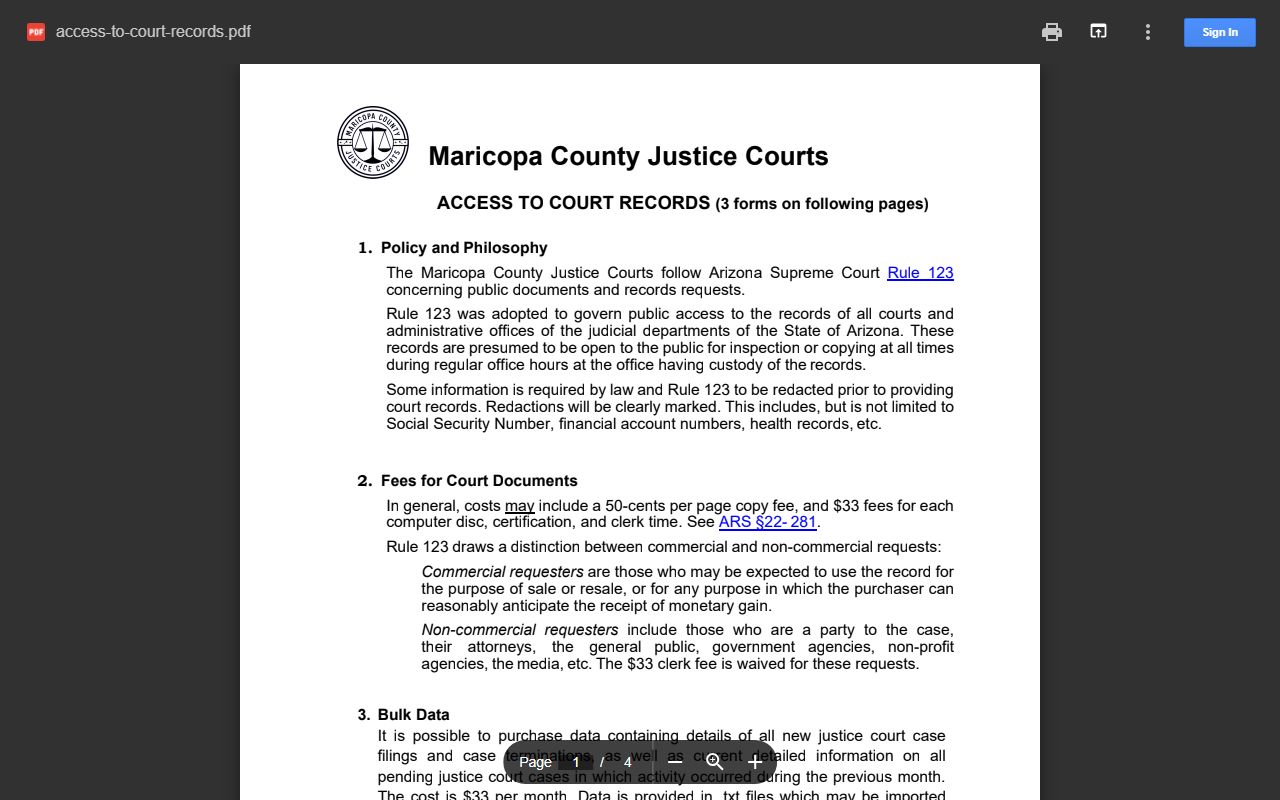
The flyer ties Rule 123 to the Justice Court intake and lists the categories that are closed by law even when the rest of the file is open.
Records That Are Not Public
Some file types are closed by law. The list below covers the most common closed or limited records held by Maricopa County offices. The base rule is access; the exceptions are narrow but real.
- Sealed criminal records under A.R.S. § 13-911.
- Marijuana expungement records under A.R.S. § 36-2862.
- Juvenile dependency, severance, and adoption files under A.R.S. § 8-208 and A.R.S. § 8-120.
- Mental-health treatment records under A.R.S. § 36-509.
- Some law-enforcement images of witnesses and victims under A.R.S. § 39-121.04.
- Grand jury materials, sealed warrants, and certain pre-sentence reports.
- Social Security numbers and other personal identifiers redacted from open files.
The Clerk and the Justice Courts will redact closed fields before release. A court order is needed to reach the sealed material in most cases.
Denials and Appeals
A denial does not end the matter. A.R.S. § 39-121.02 gives the filer a court action path. The filer can sue in Superior Court to force the office to release the file. If the court finds the denial was not reasonable, it can award costs and attorney fees and may award damages where the statute allows.
Before suing, most filers first ask the office to put the denial in writing and to cite the statute or rule used to close the record. A written denial helps the court read the case. The Arizona Ombudsman Citizens' Aide can also weigh in and may help broker an outcome short of court. For court case files closed under Rule 123, the path is a motion in the court that holds the file, not a Title 39 suit.
The Attorney General Handbook is used by many offices to read close cases. State guidance, Arizona State Library public records guidance, also helps filers know the steps. See the FAQ for common denial questions.
The state library page below sets out records-management duties for public bodies in Arizona. Source: Arizona State Library public records branch.
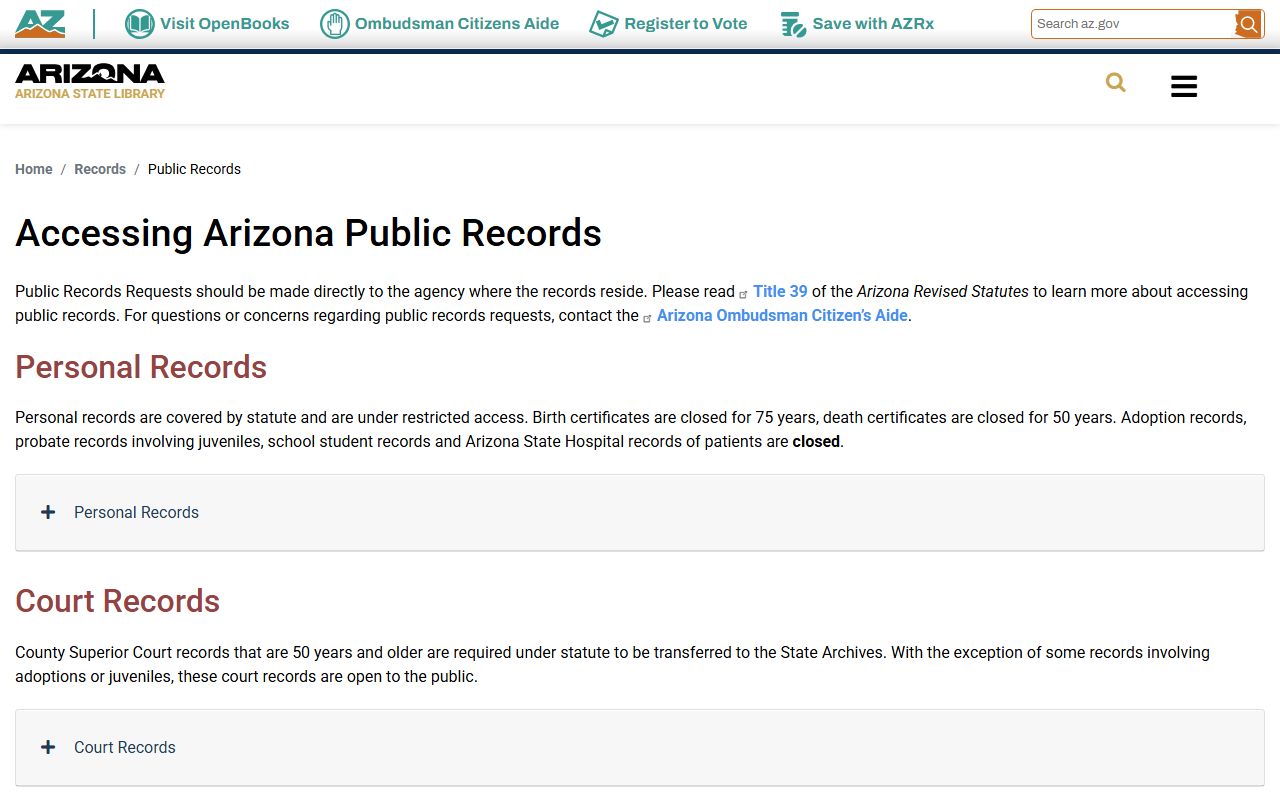
The page reinforces that public bodies in Maricopa County and statewide must keep and produce records that document official actions.
Records Held by the Clerk vs Other County Offices
One of the top sources of delay is sending the request to the wrong office. The Clerk of the Superior Court holds Superior Court case files and recorded marriage licenses. The Clerk does not hold deeds, Sheriff jail data, or Justice Court files. Knowing which office owns the data is half the work.
- Clerk of the Superior Court: Superior Court civil, criminal, family, probate, and tax case files; minute entries; marriage licenses.
- Maricopa County Recorder: deeds, mortgages, liens, and other land records.
- Maricopa County Sheriff: jail roster, booking, mugshots, civil process, and warrant records.
- County Attorney: charging files, declination notes, diversion program data.
- Justice Courts (26 precincts): small claims, eviction, civil traffic, and misdemeanor files.
- Municipal courts: Phoenix, Mesa, Scottsdale, Tempe, Chandler, and Gilbert handle their own files.
- Arizona Department of Public Safety: state criminal history records, subject to dissemination rules.
The cross-office map matters because A.R.S. § 39-121 only reaches the office that holds the record. A request sent to the Clerk for a Justice Court file goes back unfilled. Send the form to the right place the first time.
Clerk of the Superior Court in Maricopa County
Customer Service Center
601 W. Jackson Street
Phoenix, AZ 85003
Phone: 602-372-5375 (602-37-CLERK)
Hours: 8:00 AM to 5:00 PM, Monday through Friday
Clerk: Joseph W. Malka
Additional public records counters: Northwest Regional Court Center, 14264 W. Tierra Buena Lane, Surprise; Southeast Court Complex, 222 E. Javelina Ave., Mesa; Northeast Regional Court Center, 18380 N. 40th St., Suite 120, Phoenix.