
Common Questions About Maricopa County Court Records
The questions below come from the most common reasons people contact the Clerk of the Superior Court, MCSO, and the Justice Courts. Use the links in each answer to reach the right portal, office, or full topic page on this site. Search results from public dockets are good for case lookup, but they are not the official record. For court use, always get a certified copy from the correct clerk.
How do I look up a Maricopa County court case?
Most cases sit in Maricopa County Superior Court dockets for Civil, Criminal, Family, and Probate, or in a Justice Court precinct docket. Civil, Family, and Probate searches use name or case number. Criminal search lets you use a name, initials plus date of birth, or a case number. The public docket shows case history and entries but does not give you downloadable copies. For documents you can file or use in court, request a certified copy from the Clerk, use eAccess, or use ECR Online if you are a party to the case.
What does it cost to get a certified copy of a court record?
The Clerk of the Superior Court charges $0.50 per page for copies and $35.00 for certification. Exemplification is $70.00 and authentication is $105.00. E-certified court documents are $35.00. A CD reproduction is $35.00. Research to locate a file is $35.00 per year or source searched. The Clerk takes money order, debit, credit, and cash at the counter. Personal checks are not accepted. Justice Court certified copies must come from the precinct that heard the case, not the Superior Court Clerk.
Are mugshots public in Maricopa County?
MCSO publishes inmate information through its official inmate search and separate mugshot and warrant tools. Mugshots can appear with booking data, but the Sheriff warns that the data should not be used for legal action and may not be current, accurate, or complete. True identity can only be confirmed through fingerprints. See arrest records for the full rundown on what mugshots show and the gap between an arrest record and a conviction. For active custody info, the jail roster page is the right starting point.
How do I find an inmate at MCSO?
Use the MCSO Inmate Information search on the inmate records page. You can search by booking number, or by last name, first name, and date of birth in YYYYMMDD format. The Sheriff says the data should not be relied on for legal action and that some entries may not show every possible field. If the name does not appear, call MCSO or the jail information line. For people no longer in custody, see the released inmates page for state and federal release tools.
How do I check for an active warrant?
The MCSO warrant lookup is the public tool. It takes a First Name, Last Name, Agency, City, and Zip, plus keyword filtering and a More Details link. Superior Court warrant questions can also go to Criminal Department Information at 602-506-8575. Probation violation warrant questions go to 602-372-0427. The warrant records page walks through each search field and what the result entries show. A warrant stays in effect until arrest or until the issuing court resolves it.
Can I get my Arizona criminal record sealed?
Yes, in some cases. A.R.S. § 13-911 lets eligible people petition to seal arrest, conviction, and sentencing records after they finish a sentence, after a dismissal or not-guilty verdict, or after an arrest with no charges. Waiting periods and offense exclusions apply. The petition is filed with the court that handled the case. The criminal records page explains who qualifies and which records sealing covers. Marijuana expungement under A.R.S. § 36-2862 is a separate process for some pre-legalization marijuana offenses.
What is the difference between sealing and expunging in Arizona?
Sealing under A.R.S. § 13-911 hides eligible records from most public view while letting law enforcement and certain agencies still see them. The case still exists. Expungement under A.R.S. § 36-2862 is the marijuana-specific path that vacates and clears certain qualifying pre-legalization marijuana offenses. Arizona does not offer a broad expungement for most criminal records. Most people who want a clean public record use sealing. See criminal records for a side-by-side and links to the Law Library Resource Center forms.
How do I get a Maricopa County marriage license?
The Clerk of the Superior Court issues marriage licenses. The license fee is $98.00. Arizona residents may use the online marriage license program if eligible. In-person service is open at Downtown Phoenix, Northeast, Northwest, and Southeast Clerk locations. You get the license the same day you apply in person, and you can be married the same day if you have an officiant ready. The officiant must return the signed license within 30 days. See the marriage and divorce records page for steps and ID rules.
How do I file for divorce in Maricopa County?
Divorce is a Family Court matter in Maricopa County Superior Court. The Law Library Resource Center has the petition forms, parenting plan, and child support worksheet. File at the Clerk's Customer Service Center or by approved electronic filing. Once filed, search the Family Court docket by last and first name or case number for status updates. The divorce records page lists the search portal, what is public, and what stays restricted. For certified decrees, request copies from the Clerk after the case closes.
How do I search probate records?
Use the Superior Court Probate Court Case Information portal. It supports last name, first name, and case-number searches. Most probate estate filings are public, but mental-health records, protected-person reports, juvenile or adoption-related matters, and sealed filings stay confidential. Copies and certified copies come from the Clerk of the Superior Court. The probate records page explains terms like testator, executor, and intestate, and lists the PLAP phone consultation hours for low-income probate self-represented filers.
What is ECR Online?
ECR Online is the Clerk's electronic court records portal for registered users who are parties to certain case types. It gives access to documents that the public docket does not show. The general public docket displays case history and entries but no document images. For unrestricted public case records and documents on a fee basis, statewide eAccess offers 24/7 viewing. See the court records page for a side-by-side of the public docket, ECR Online, and eAccess.
Who is the Clerk of the Superior Court?
Joseph W. Malka is the Clerk of the Maricopa County Superior Court. The Clerk's office files case documents, keeps the official court record, issues marriage licenses, takes fee deferral and waiver requests, and handles certified copies. The downtown Customer Service Center is at 601 W Jackson, Phoenix, AZ 85003. The office also runs Northeast, Northwest, and Southeast locations. The Clerk of Court page lists each address, phone, and the records request form fields.
How long does a public records request take?
Response times vary by office, request size, and whether records need redaction. The Arizona Public Records Law, A.R.S. § 39-121, says public records are open for inspection at all times during office hours. A.R.S. § 39-121.01 covers the duty to keep and produce records, and § 39-121.03 covers commercial-purpose requests. Simple requests can take days; complex pulls can take weeks. The public records page lays out the request steps, the form fields, and the fee schedule.
What does the Maricopa County Attorney do?
The Maricopa County Attorney's Office, led by Rachel Mitchell, prosecutes felony criminal cases filed in Maricopa County Superior Court and gives legal advice to county departments. MCAO has more than 900 full-time employees. Victim Services and the Victim Compensation Program run through MCAO and the Clerk. MCAO does not handle Justice Court misdemeanors that are prosecuted by city attorneys or other agencies. For prosecutor records, see the criminal records page or contact MCAO directly.
Are juvenile records public in Arizona?
Some juvenile delinquency records are public under A.R.S. § 8-208. Adoption, severance, and dependency records are not open to the public except as the law allows. The court can also keep records confidential when there is a clear public interest. Victim identity must be protected, and school records fall under FERPA. The court records page explains which juvenile material a docket search may show and which stays sealed by default in Maricopa County Superior Court.
How do I find federal cases that touch Maricopa County?
Federal civil and criminal cases for the District of Arizona are searched through PACER, which covers U.S. District Court, U.S. Bankruptcy Court, and U.S. Court of Appeals filings. Federal custody data uses the BOP Inmate Locator. State prison releases use ADCRR Inmate Data Search. The Superior Court page on this site explains the Maricopa County Superior Court structure, which is separate from federal courts. For federal court records direct, start at the PACER Service Center.
Where can I get free legal self-help?
The Law Library Resource Center is linked across Superior Court pages for Civil, Criminal, Family, Juvenile, and Probate forms. The statewide Arizona Courts Self-Service Center at azcourts.gov/selfservicecenter has forms and instructions for name change, divorce, small claims, eviction, garnishment, sealing, and more. PLAP gives probate self-represented filers up to a 30-minute phone consult on Wednesdays at 602-732-2834. Public Defense Services coordinates indigent criminal defense. The State Bar of Arizona has a lawyer referral line for private attorneys.
The Arizona Courts Self-Service Center is the broadest free starting point, with form packets for the topics most often raised by self-represented filers. A screenshot of the site is below.
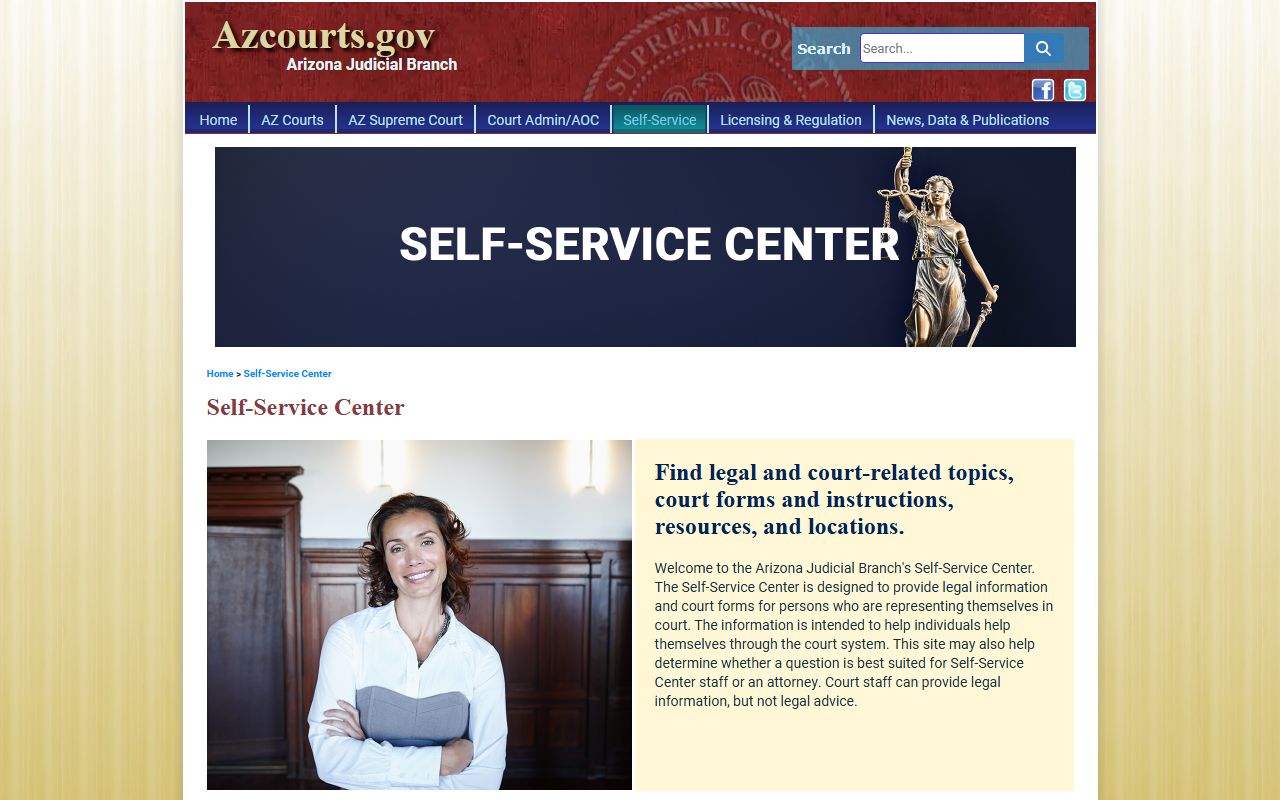
The Self-Service Center pairs well with the Law Library Resource Center for in-county help and with PLAP for probate-specific questions. Use the site to confirm the form packet, then file at the Clerk's office that matches your case type.
Note: Online docket data is informational only and the Clerk's certified copy remains the official proof of any Maricopa County court filing.
How do I find the right Justice Court precinct?
Maricopa County has 26 Justice Court precincts. A 27th West Valley court is set to open January 1, 2027. The county's official locator asks you to enter an address on the Maricopa County Interactive Elections Map to find the correct precinct. Justice Courts handle small claims, civil suits and evictions up to $10,000, traffic, misdemeanors, protective orders, and marijuana expungements. Records and certified copies come from the precinct that heard the case. See court records for the case-search portal link.
How do I put money on an inmate account at MCSO?
MCSO uses TouchPay. Deposits can be made by phone at 1-866-355-9593, online at TouchPay, at select retail locations using the TouchPay locator, or at cash kiosks in the jail facilities. Kiosks take cash, Visa, and MasterCard. Deposits use the inmate's name or booking number and usually post within an hour after verification. The inmate records page covers the full deposit options, visitation rules, and the contact lines for each jail facility.
What can I bring into the courthouse?
Expect security screening. Firearms, knives, pepper spray or mace, tools, flammable liquids, cannabis, sharp objects, and recording equipment are not allowed without approval. Visitors empty pockets, place bags on the X-ray belt, remove belts, and walk through a metal detector. The Security page recognizes service animals under A.R.S. § 11-1024 and has accommodations for pacemakers, prosthetics, wheelchairs, children, and medically prescribed items. Cameras and portable electronic recording in a courthouse are barred without approval under Arizona Supreme Court Rules 122 and 122.1.
Still Have Questions?
For the right office, see Clerk of Court. For broader access rules, see public records. For records-by-topic, browse court records, criminal records, inmate records, warrant records, marriage and divorce, or probate.