
How to Find Recently Released Maricopa County Inmates
MCSO runs the front-end record for anyone booked into the county jails. Start with the MCSO Inmate Information page. A name search returns the most recent booking record, and the page flags release status when the person is no longer in custody. If a person was in custody yesterday but does not appear today, that is the usual sign of a release. The same record will sometimes display a release date or a transfer note when the inmate was moved to a state prison or to a federal facility.
Booking numbers help. If you have the booking number from a prior alert or court filing, the lookup is exact. If not, search by last name and date of birth. Common names return long lists, so a date of birth narrows the result fast. The Sheriff is Jerry Sheridan. His office books and releases roughly 81,677 people each year across the county system, and the records line at 602-876-0322 can confirm a release that the online tool does not yet show.
The release path matters. Some people walk out on bond, some on time served, and some are picked up by another agency on a hold. The path drives where to look next.
Note: The online record may lag the actual release by a few hours, so call the jail records line if a same-day confirmation is needed.
VINELink Release Notifications
VINELink is the public-facing piece of the national VINE network. It sends phone, text, or email alerts when a registered offender is released, transferred, or has a status change. Victims and family members use it the most, but anyone can register. The service is free. Sign up through VINELink and pick Arizona as the state. Maricopa County jail data feeds into VINE through MCSO, and state prison data flows in through the Arizona Department of Corrections, Rehabilitation and Reentry.
A short walkthrough of the VINELink alert setup:
- Open the VINELink homepage and select Arizona from the state map or dropdown.
- Search by offender name or offender ID, then pick the right match from the result list.
- Click "Register" on the profile, enter a phone, email, or text contact, and choose a four-digit PIN to stop the alert when it comes in.
VINELink covers custody status only. It does not replace court orders, protective orders, or direct jail confirmation. The alert tells you the person's custody changed; it does not tell you where they are going. For a current jail status before signing up for alerts, check the Maricopa County inmate records page first.
An image of the VINELink interface, sourced from vinelink.com, shows the state selection step and the offender search box used to start a notification setup.
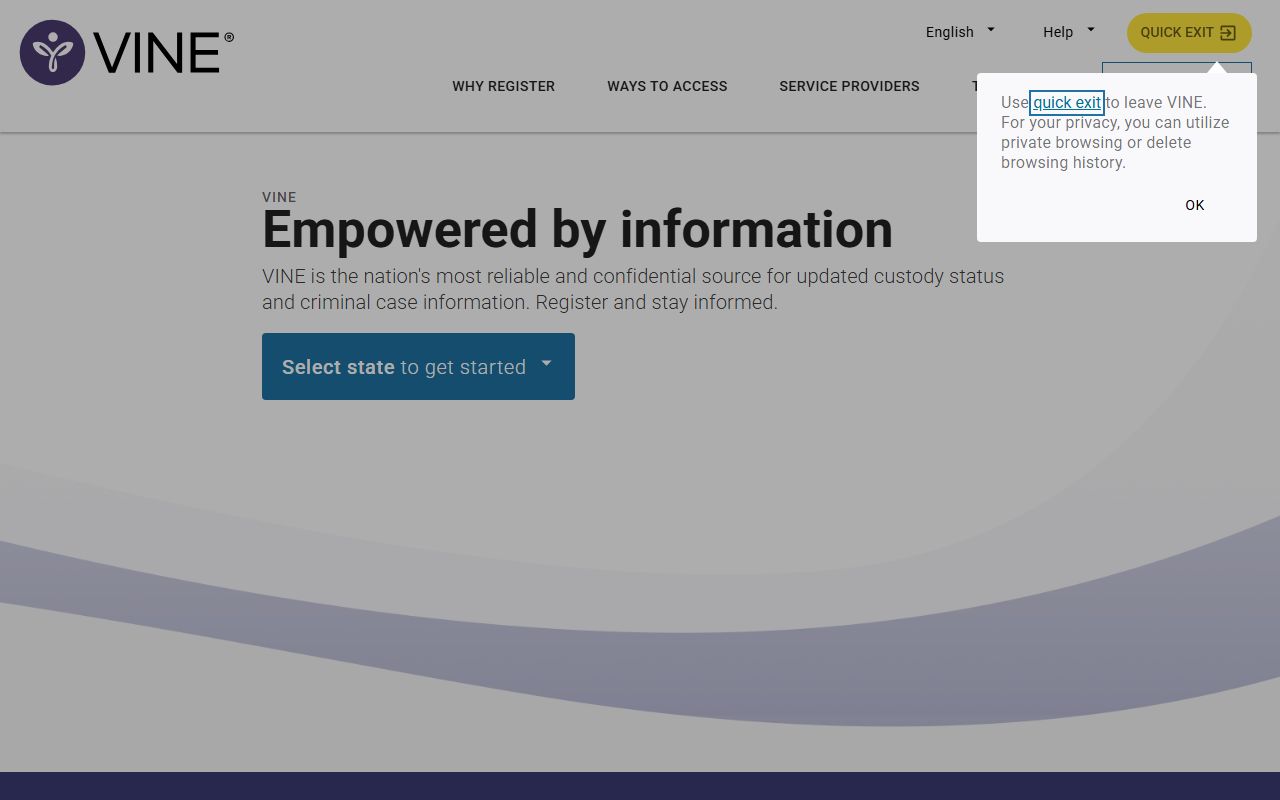
VINE participation depends on the local agency feeding data in. Maricopa County jails and Arizona state prisons both participate, which means most county and state releases trigger an alert. Federal releases do not flow through VINE; for those, use the BOP locator below.
Arizona DOC Inmate Datasearch
If a Maricopa County case ended in a prison sentence, the person was moved out of county custody and into the Arizona Department of Corrections, Rehabilitation and Reentry (ADCRR). The state agency keeps a public locator called Inmate Datasearch. Search it at corrections.az.gov/public-resources/inmate-datasearch. The page accepts a name search or an ADC number search and returns current status, location, and projected release date when available.
The search form is small, and the field set is shown below.
| Field Label | Type | Required | Notes |
|---|---|---|---|
| ADC Number | Text | Optional (one search path) | State prison number. Exact match. |
| Last Name | Text | Optional (one search path) | Public inmate search by name. |
| First Name | Text | Optional | Narrows the name search. |
| Gender | Dropdown / filter | Optional | Filter exposed in the application iframe. |
| Search / Reset | Buttons | n/a | Standard form controls. |
A search returns a profile card. The field set on a typical ADCRR result is below.
| Field | What It Shows |
|---|---|
| ADC Number | State inmate number used across all ADCRR records. |
| Name and Aliases | Legal name and any known aliases on file. |
| Status | Active, Inactive (Released), Absconder, or Deceased. |
| Location / Unit | Current housing facility or community supervision office. |
| Projected Release Date | Earliest expected release; subject to change. |
| Offense and Sentence | Conviction offense, county of conviction, sentence length. |
An ADCRR screenshot, sourced from corrections.az.gov, shows the public landing page where the data search starts.
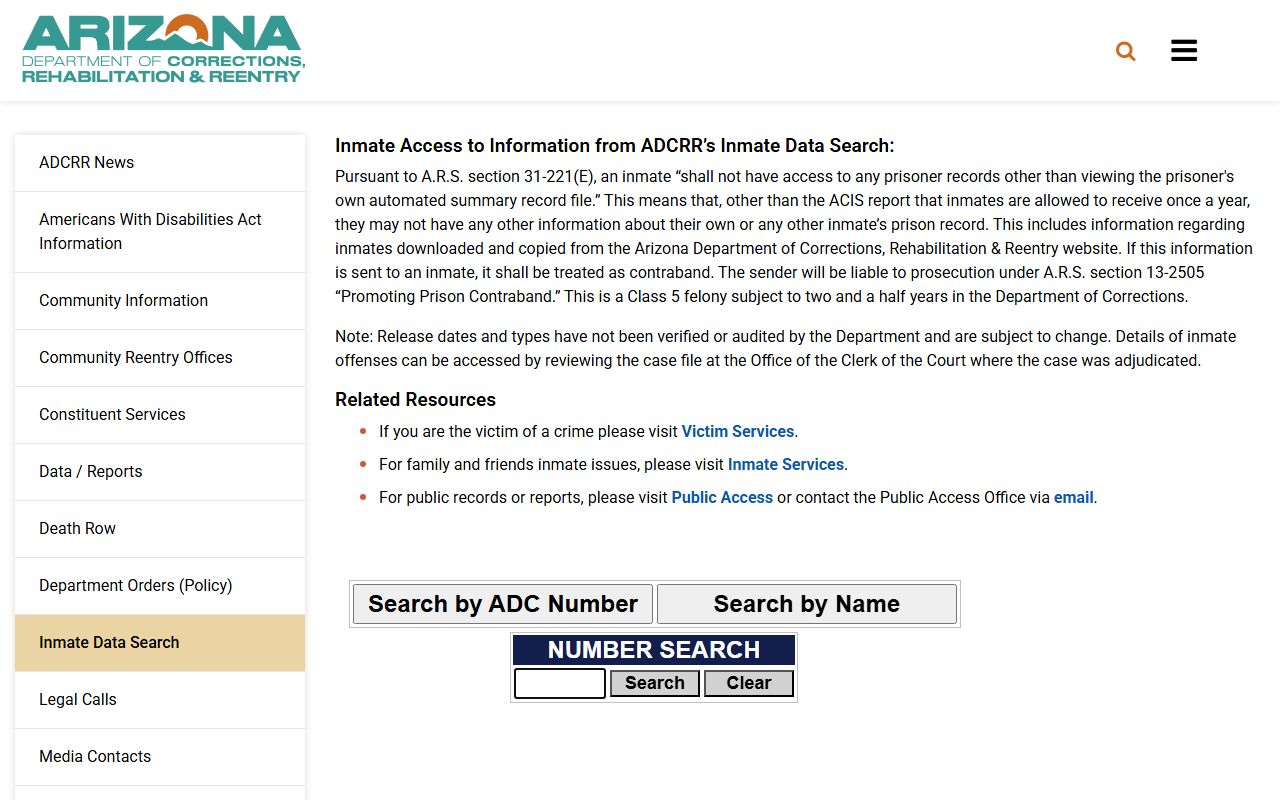
Two warnings ride with the data. Under A.R.S. § 31-221(E), inmates cannot access prisoner records except their own automated summary file, and sending downloaded inmate data to a person in custody can be treated as contraband under A.R.S. § 13-2505. ADCRR also says release dates and types are not audited and may change.
Federal BOP Inmate Locator
Federal cases out of the District of Arizona end in the Federal Bureau of Prisons, not in state prison. To find a federal inmate or to confirm a federal release, use the BOP Inmate Locator. The tool covers federal inmates from 1982 to the present, and it includes a "Released" status for people no longer in BOP custody.
BOP gives two search tabs. One searches by number, one searches by name. The field list:
| Field Label | Type | Required | Notes |
|---|---|---|---|
| Find By Number | Tab | n/a | BOP Register Number, DCDC Number, FBI Number, or INS Number. |
| Number | Text | Yes for number search | Exact match required. |
| Find By Name | Tab | n/a | Name plus demographic filters. |
| First | Text | Optional | First name field on the name search. |
| Middle | Text | Optional | Middle name field. |
| Last | Text | Required for name search | Last name is the only required name field. |
| Race | Dropdown | Optional | BOP filter. |
| Age | Numeric | Optional | BOP filter. |
| Sex | Dropdown | Optional | BOP filter. |
The BOP landing page is shown below, captured from bop.gov/inmateloc.
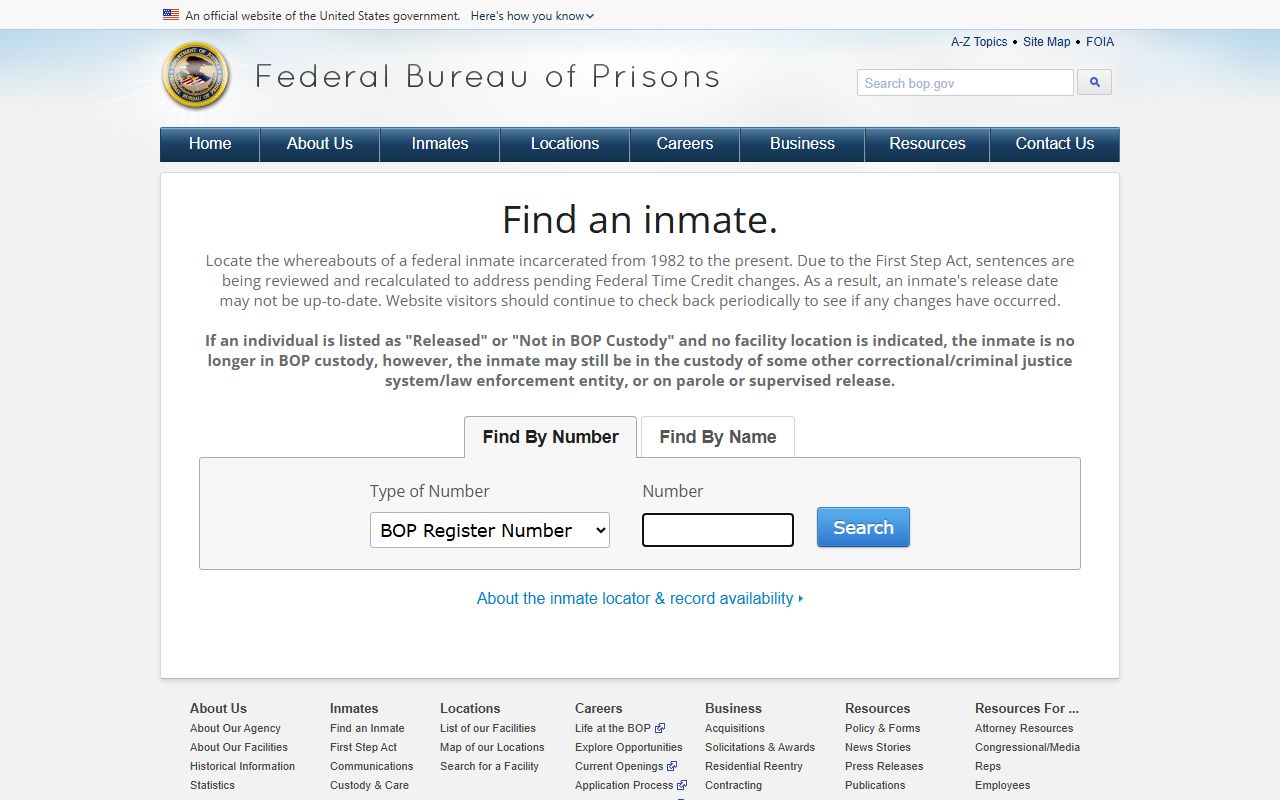
One caution. BOP notes that release dates may not be current because of First Step Act recalculations, and a "Released" status does not rule out supervised release, halfway-house placement, or another custody status with a different agency. For confirmation, the regional BOP office handling the case file is the better call.
Verifying Release In Person or By Phone
Online records lag. When the answer has to be right, in real time, a phone call works better. The MCSO main line is 602-876-1000. The jail records line is 602-876-0322. Both can confirm a current custody status. A staff member can verify whether the person walked out on bond, was released on own recognizance, or was transferred to ADCRR or to the U.S. Marshals Service.
The release procedure has steps. Detention officers review the release order, run a wants-and-warrants check, and verify the inmate's identity before opening the door. A release that follows a bond requires the issuing court to confirm payment first. A release that follows initial appearance may set conditions before the inmate leaves. A release on sentence completion ends with a property and money return under MCSO procedures.
Property pickup follows its own rules. The MCSO Information for Families page states the pickup location is given by the inmate, and anyone picking up property must show a valid government-issued photo ID. Money release requests after 72 hours in custody require approval from the jail commander or designee. Cashier's checks and U.S. currency are accepted for certain jail processes, subject to verification, and any check should be made out to MCSO where applicable.
For an active criminal case tied to the release, the case file lives with the Clerk of the Superior Court, Joseph W. Malka, at the Central Court Building, 201 W Jefferson St, Phoenix, AZ 85003. The Clerk's office can confirm a court-ordered release condition such as electronic monitoring or pretrial supervision.
Sex Offender Registry (AZ DPS)
Arizona keeps a public sex offender registry through the Department of Public Safety. Anyone released from jail or prison who is required to register is added to the state list, and community notification follows under A.R.S. § 13-3827. Search the registry at azdps.gov/Services/Sex_Offender. DPS verifies name, address, and photograph for each registered offender in Arizona.
The registry search exposes a small field set.
| Field Label | Type | Required | Notes |
|---|---|---|---|
| Offender Search | Link / button | n/a | DPS links out to the public registry search. |
| Name | Text | Optional | Search by full or partial name. |
| Address / City / Zip | Text | Optional | Search by geography in the map interface. |
| Radius / Area | Dropdown / filter | Optional | Map radius filter for nearby registrants. |
A registry profile shows a set of public fields. The list below is typical.
| Field | What It Shows |
|---|---|
| Name and Aliases | Legal name and any aliases on record. |
| Photo | Most recent verified photo on file. |
| Risk Level | Community notification level set at sentencing or release. |
| Registered Address | Current address verified by DPS. |
| Offense | Conviction offense triggering registration. |
| Compliance Status | In compliance, non-compliant, or absconder. |
A DPS page screenshot, sourced from azdps.gov, shows the compliance and registration landing page.
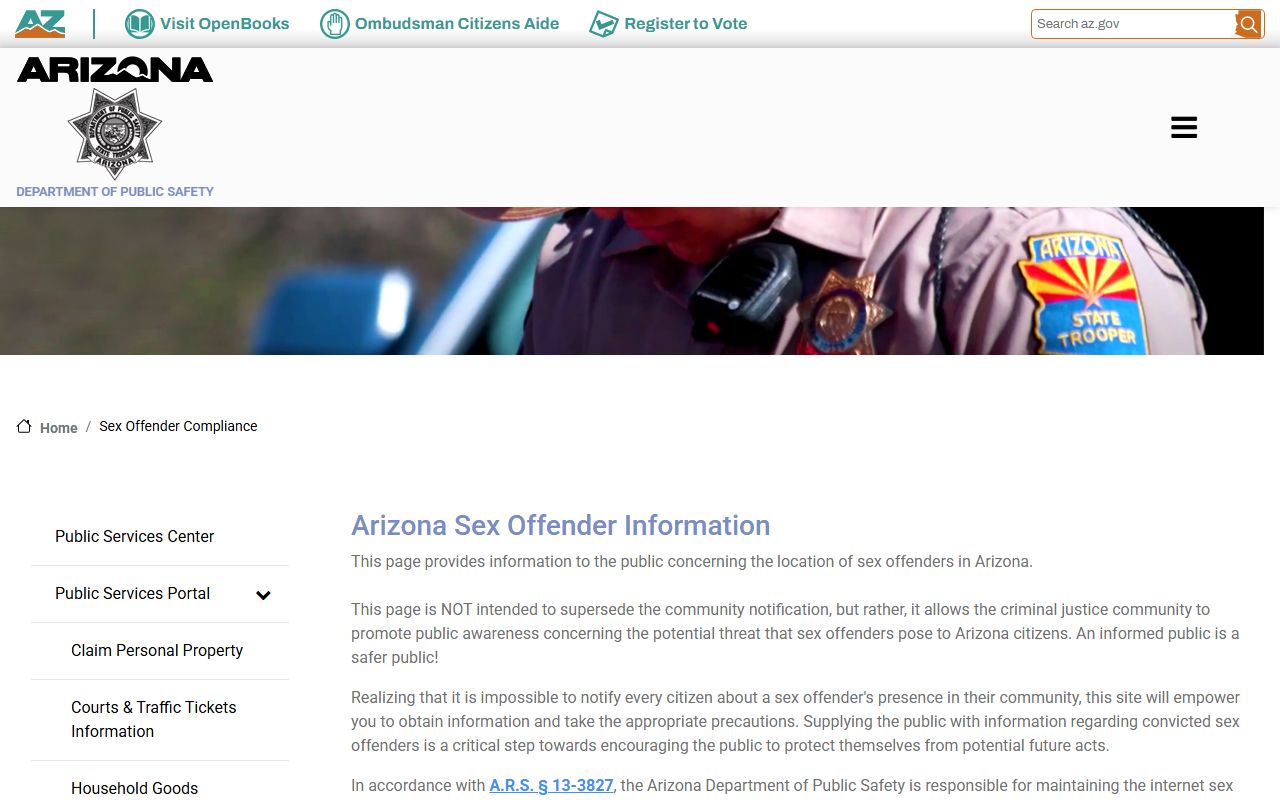
The registry is a public-safety tool. It is not a credit, employment, or tenant screening tool. Use of registry data for any FCRA-regulated purpose is barred.
Parole & Probation Information
Arizona ended discretionary parole for most offenses in 1994, but a Board of Executive Clemency still hears commutation, pardon, and parole-eligible cases (for older convictions or special categories). The Board sets conditions, hears revocation matters, and refers serious violations back to the court or to ADCRR. Probation in Maricopa County is supervised by the Maricopa County Adult Probation Department, with caseloads split across standard, intensive, and specialty caseloads tied to drug court, mental health court, and DUI court.
Arizona Board of Executive Clemency
1645 W Jefferson St, Suite 326
Phoenix, AZ 85007
602-542-5656
A supervision officer is the first point of contact for any concern about a person on parole or probation. The supervision officer handles violations, transfer requests, and address changes. The supervising officer's name and contact information appear in the case file kept at the Clerk's office. Violation reports tied to a Maricopa County conviction are filed at the Maricopa County court records system and may produce a new warrant; for an active warrant tied to a violation, check the warrant records page.
Note: A revocation hearing can return a person to custody, so a release status from VINE may be followed within weeks by a new booking record at MCSO.
Reentry Resources in Maricopa County
Reentry support runs across county human services, the Maricopa County Attorney's Office (Rachel Mitchell), the Arizona Courts self-service center, and a set of nonprofit providers. Housing, jobs, treatment, and record relief are the four pillars. The court system also offers post-conviction relief that can make a record easier to live with.
- Arizona Courts record sealing for post-release record relief under A.R.S. § 13-911.
- MCAO Diversion Programs for charging-stage and post-conviction diversion options.
- Arizona Courts Self-Service Center for forms, marijuana expungement, and restoration packets.
- Maricopa County Public Defense Services for legal aid with sealing, expungement, and rights restoration.
- MCAO Victim Services for victim support and the state Victim Compensation Program.
The Law Library Resource Center inside the Superior Court houses self-help forms across criminal, civil, family, juvenile, and probate matters. The Probate Lawyers Assistance Program at 602-732-2834 offers a free 30-minute consult on Wednesdays from 9 AM to noon for eligible low-income people; non-eligible callers pay a $40 cash fee. For broader public legal information, the Arizona Court Help portal, the State Bar of Arizona lawyer referral service, and the Public Defender's office cover most needs.
Treatment, jobs, and housing connections come through county Human Services, Arizona@Work, and community behavioral health providers. Eligibility for sealing under A.R.S. § 13-911 depends on conviction count, sentence completion, and restitution status; the self-service center forms include a checklist that walks the petitioner through eligibility.
Civil Rights Restoration After Release
Arizona restores most civil rights after a sentence ends, but the path depends on the conviction count and the offense type. A.R.S. § 13-905 covers the setting aside of a judgment and the restoration of civil rights for first-time felony cases on completion of probation or sentence; for multiple felonies, the law sets a waiting period before a petition can move forward. Restoration touches four rights: voting, jury service, holding public office, and firearm possession.
Voting rights restore by operation of law for a first felony once the sentence (including probation, restitution, and fines) is complete. A second or later felony requires a court petition for restoration. Firearm rights take a separate petition, and a "serious offense" under A.R.S. § 13-706 cannot get firearm rights back. The court that handled the conviction is the court that handles the restoration petition; for Maricopa County convictions, that means the Superior Court at 201 W Jefferson St, Phoenix.
Two other relief paths help with the record itself. A.R.S. § 13-911 sealing seals a criminal case from public view but keeps it visible for sensitive employment and background checks. A.R.S. § 36-2862 marijuana expungement erases qualifying marijuana convictions and can restore firearm rights unless another bar applies. The forms for both live on the Arizona Courts self-service center, and the Clerk of the Superior Court accepts the filings. For related case-file lookups, the court records and arrest records pages cover the search side.
One last note on background checks. A sealed record still shows up for FBI fingerprint checks tied to law enforcement, child care, and certain professional licenses. The sealing order can be raised in a civil employment discussion, but it does not stop every check. For people facing rejection on a check after release, the Public Defender's office and Arizona Court Help can point to next steps.