
What Probate Covers in Maricopa County
Probate is the court process that moves a person's estate from the deceased to the heirs. It also covers cases where an adult or child needs someone to act on their behalf. In Maricopa County the Probate and Mental Health Department of the Superior Court hears all of these matters. The judge can admit a will to probate, name a personal representative, set up a guardianship for a minor, or approve a conservatorship over the funds of an adult who can no longer manage them.
The same department handles court-ordered mental health treatment. That part of the docket is kept apart from estate files because the records carry strict privacy rules. Trust disputes that need a judge's order also land here. Most estate files are open to the public, but some pages inside the file may be sealed. A short list of what the department covers helps make the scope clear.
- Wills and estates of people who died in the county.
- Formal and informal probate cases.
- Appointment of a personal representative.
- Guardianship of a minor or adult.
- Conservatorship over the funds of a protected person.
- Trust matters filed with the court.
- Mental health proceedings under state law.
Probate Terms Defined
Probate files use words that do not show up in daily life. A quick read of the key terms helps when looking through a case file or a fee chart. The list below is short and stays in plain English. These same terms come up on the Probate and Mental Health Department page and on most court forms.
- Testator
- The person who made the will. A testator must be of legal age and of sound mind when the will is signed.
- Executor
- The person named in a will to carry out its terms. In Arizona this role is most often called the personal representative.
- Intestate
- Dying without a valid will. State law then sets the order of heirs and the share each one gets.
- Guardianship
- A court order that gives one adult the right to make personal or medical choices for a minor or for an adult who cannot do so.
- Conservatorship
- A court order that puts one adult in charge of the money and property of a protected person.
Note: A guardian acts for the person; a conservator acts for the money, so a single case can have both roles open at once.
Maricopa County Probate Court
The Probate and Mental Health Department sits inside the Maricopa County Superior Court. The main hub for filings is the East Court Building in downtown Phoenix. The Old Courthouse next door holds the public information window. Mental health hearings often run at hospital sites so patients can take part in person. Each site is open to file papers, set hearings, and ask for help.
The Probate and Mental Health Department page lists hours, judges, forms, and contact lines. It also points to the free Probate Lawyers Assistance Program, known as PLAP. Court staff cannot give legal advice. PLAP fills part of that gap for low-income self-represented litigants who meet the program rules.
For a full look at the department, see the Probate and Mental Health Department page, which lists every probate site in the county and gives general filing tips.

The page links to forms for formal and informal probate, guardian and conservator filings, and mental health petitions. It is the best place to start before driving downtown.
How to Search Maricopa County Probate Records
The Superior Court runs a free name and case number tool for probate files. It is open to the public with no login. The tool pulls from the court docket and shows party names, case type, filing date, and the next hearing. Older files may not show in full and may still need a trip to the court window.
Before you start, write down the full legal name of the deceased or the protected person. Note the year of death or the year the case was filed. That helps when many people share a name. The Probate case search takes a last name and first name, or a case number.
- Open the Probate case search portal in any web browser.
- Pick the search type. Use Last Name and First Name to look up a person, or use Case Number when you have the docket ID.
- Type the name or case number into the form fields. Spelling counts.
- Click Search to submit the query.
- Scan the list of results. Click a case to see the docket entries.
- Note the case number, file date, and judge for any case you want to view in full.
- Go to the East Court Building or Old Courthouse to view sealed pages or to ask for paper copies.
For a look at the search form itself, view the Probate case search form.
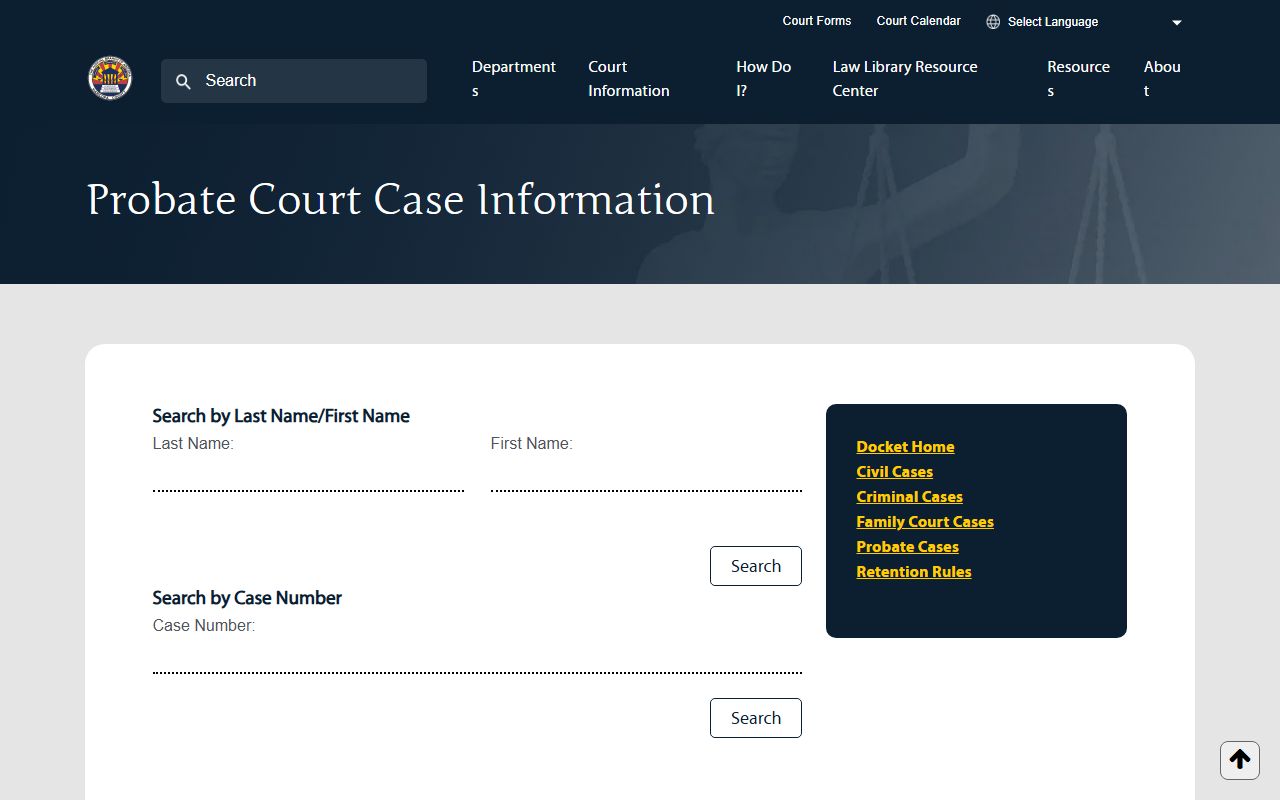
The screen is short and works on a phone. Results open in the same window and link to the docket page for that case.
Probate Filing Fees
Most probate cases need a filing fee at the time the petition is filed. The Clerk of the Superior Court sets the fees through a court-wide schedule. The amounts cover the petition, copies, and the work of certifying the file. Fees are paid in cash, by check, or by card at the Clerk's window. Low-income filers may ask for a fee deferral or waiver.
| Item | Where to verify |
|---|---|
| Original probate petition | Clerk of the Superior Court fee schedule |
| Letters testamentary or letters of administration | Clerk of the Superior Court fee schedule |
| Certified copy per page | Clerk of the Superior Court fee schedule |
| Guardianship or conservatorship petition | Clerk of the Superior Court fee schedule |
| Demand for notice | Clerk of the Superior Court fee schedule |
| Probate act not otherwise provided | Clerk of the Superior Court fee schedule |
| PLAP paid consultation | $40 cash, by appointment |
The fee schedule changes over time. The Clerk posts the latest rates on the court website. Confirm the exact dollar amount with the Clerk before you mail in a petition.
Note: A fee waiver request must be filed at the same time as the petition, and the judge can grant it in full, in part, or as a deferred payment.
Small Estate Affidavit
Not every estate needs a full probate case. Arizona law lets the heirs of a small estate skip court by signing an affidavit. The rule is set out in A.R.S. § 14-3971. The statute sets the value cap, the wait time after death, and the form the heirs must use. The affidavit is shown to the bank, the title office, or any party that holds estate assets.
The statute has two main tracks. One covers personal property such as bank funds, stocks, or a car title. The other covers real estate up to a set value. Each track has its own wait period and its own value cap. The exact dollar limits change with state law, so check the current text before you sign the form.
For the live text and any updates, view A.R.S. § 14-3971 on the Arizona Legislature site.
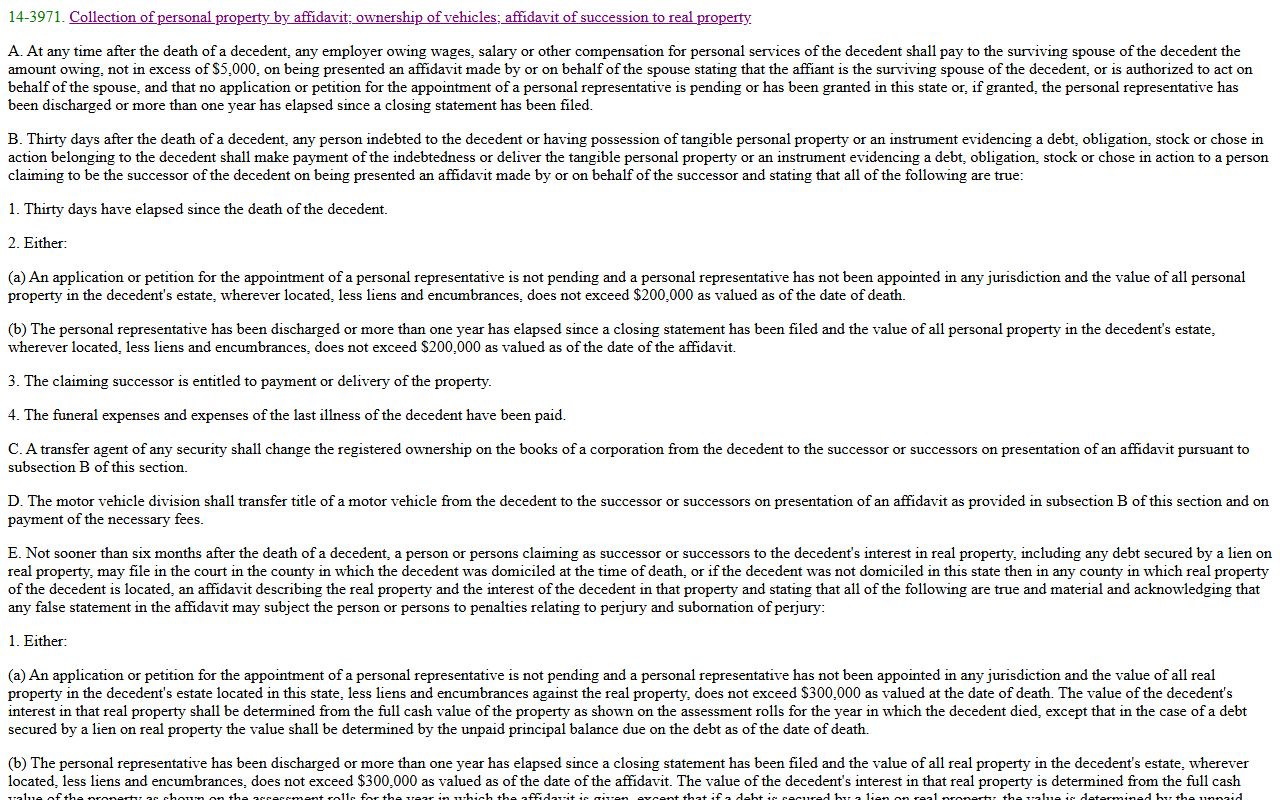
The page lists the value caps, the wait time after death, and the proof the heirs must keep with the signed form.
Guardianship and Conservatorship
Guardianship and conservatorship cases run on the same probate docket as wills and estates. A guardian is named for a child whose parents cannot care for them, or for an adult who can no longer make safe choices. A conservator is named to hold the funds of a protected person. The same person can serve as both, but each role has its own duties and its own bond.
Each case has yearly reports. The guardian files a status report on the ward. The conservator files an account that shows what came in, what went out, and what is left. The court reviews both. If the reports are late or short, the judge can call a hearing. Guardians and conservators must also pass training set by the court.
Some pages inside these files are sealed. Medical notes, school records, and bank data are kept out of public view. The case index still shows the case number and the names of the parties, but the inner pages need a court order to see.
Mental Health Court Coverage
The Probate and Mental Health Department hears civil mental health cases. The court can order short-term or long-term treatment when a person is a danger to self or others. Hearings are quick and often held at the hospital where the patient is being treated. State law gives the patient the right to a lawyer and to an exam by a doctor.
The treatment record itself is closed. A.R.S. § 36-509 keeps these files private. The court order and the case caption may be public, but the medical notes are not. A patient or a person with written consent can ask for a copy. Outside parties need a court order. The case sits on the probate docket but does not show up in standard probate name searches in most cases.
Hearings may be held at Valleywise Behavioral Health centers in Phoenix, Mesa, and Maryvale, or at the Arizona State Hospital. The court runs in those sites to keep the patient close to care. Court staff can give the time and place once a case is filed.
Certified Copies
A certified copy is a paper copy with a court seal and a clerk signature. Banks, title firms, and out-of-state courts need certified copies. A plain print from the online docket is not the same. The Clerk of the Superior Court sells certified copies at the Old Courthouse public window or by mail. Each page has its own fee, and the seal is added to the last page.
- Find the case number through the online docket search.
- List the exact pages you need by docket entry number.
- Take or mail the list to the Clerk with payment for the per-page fee and any mail fee.
- Wait for the Clerk to pull the file, scan or copy the pages, and add the seal.
- Pick up the order at the window or wait for the mail to arrive.
For mail orders, send a check made out to the Clerk of the Superior Court. Include a self-addressed return envelope. For more on the Clerk's role across all case types, see Clerk of Court.
Probate Department Contact
The Probate and Mental Health Department keeps two main public sites in Phoenix. Use these for filings, hearings, and copy requests. PLAP runs from the East Court Building on Wednesdays by phone.
Probate and Mental Health Department
East Court Building
101 W Jefferson St
Phoenix, AZ 85003
PLAP: 602-732-2834
Filings, civil probate, mental health
Probate Public Information
Old Courthouse
125 W Washington St
Phoenix, AZ 85003
Customer Service: 602-506-3204
Records counter, certified copies
Restrictions on Probate Records
Most estate files are open to the public. Anyone can walk in, ask for the case number, and read the file. But some kinds of probate records are closed by law or by court order. The rules try to keep the case open while still guarding private health, money, or family data.
- Mental health treatment records are kept private under A.R.S. § 36-509.
- Guardianship files for minors are sealed in part or in full.
- Conservatorship files may have sealed bank and medical data.
- Adoption-linked probate matters are restricted.
- Trust records can be sealed when the judge finds a good cause.
To get a sealed page, a party must file a motion and show a legal need. The judge will weigh the need against the privacy rule. For broader court file rules, see court records and the public records page.