
Criminal Records in Maricopa County
Criminal records in Maricopa County come from three places. Police and MCSO create the arrest record when a person is booked. The Maricopa County Attorney's Office, led by Rachel Mitchell, files the charges. The Superior Court Criminal Department then opens the case file once charges land in court. Each step adds a new layer of record. The booking file holds the mugshot, fingerprints, and initial charge list. The court file holds the indictment, motions, plea, and disposition.
An arrest is not the same as a conviction. A person can be booked and released with no charges ever filed. A person can be charged and later have the case dismissed. Only a guilty verdict or a guilty plea creates a conviction. Treat each record type on its own terms. Arrest data shows what police did. Court data shows what the case did.
The Superior Court Criminal Department page lays out felony case flow from first appearance through sentencing. The department covers post-conviction matters, sealing petitions, and set-aside requests too.
The official criminal department page shows the felony case flow and quick links for bonds, sealing, and self-surrender.
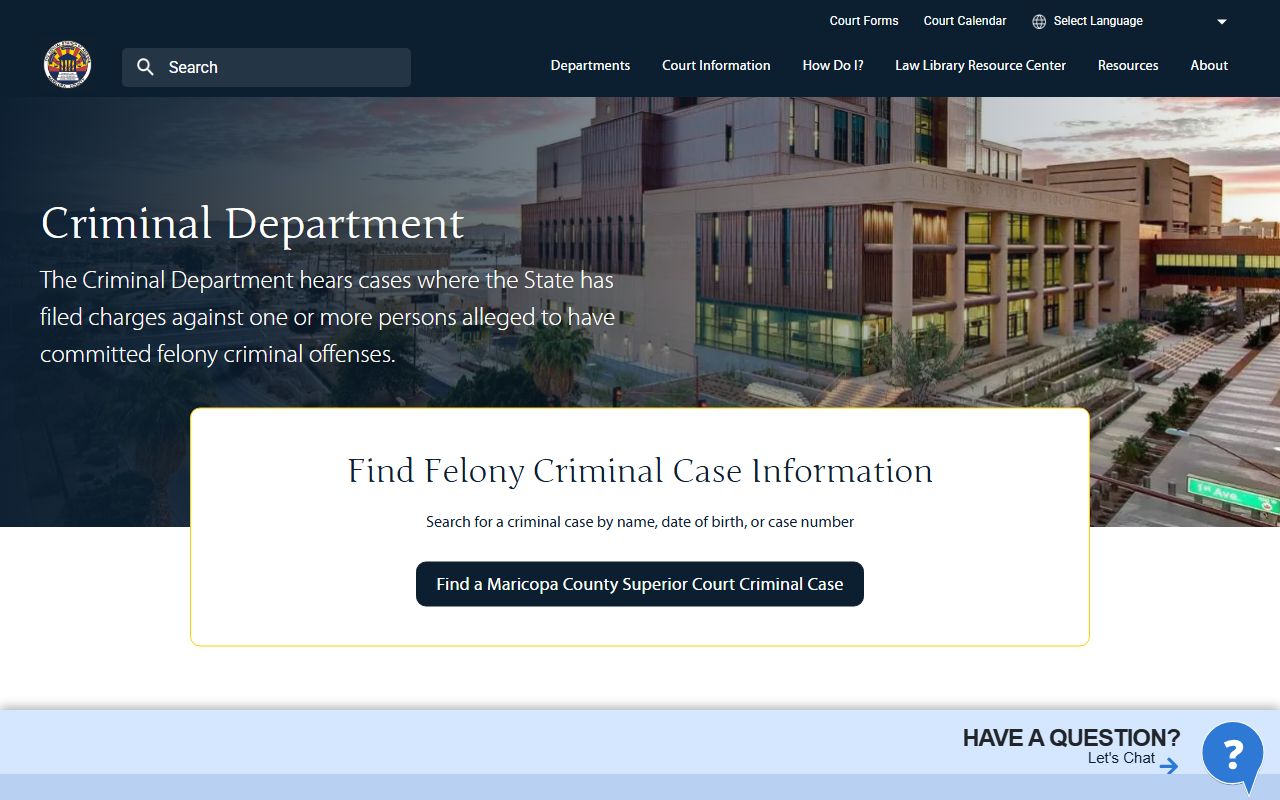
The same page links to bond payment steps, warrant self-surrender procedures, and post-conviction relief options for Maricopa County criminal cases.
How to Search Maricopa County Criminal Records
The main public portal for adult felony cases is the Superior Court Criminal Court Case Information search. The portal supports lookup by name, by initials plus date of birth, or by case number. Most people search by name first. The case number is faster if you already have it.
- Open the Criminal Court Case Information page on the Superior Court site.
- Pick a search mode: name, initials with DOB, or case number.
- Enter the last name and first name, or paste in the case number (format like CR2023-100000).
- Submit and review the result list. Click a row to load the docket.
- Read the docket entries top to bottom for the full timeline.
If the case is a misdemeanor or a traffic matter, the file lives in a Justice Court or a Municipal Court, not Superior Court. Use the Justice Court case search for those. Statewide criminal history reports go through the Arizona Department of Public Safety, not the county.
The criminal case search form asks for name fields and offers an initials plus date of birth option for tighter matches.
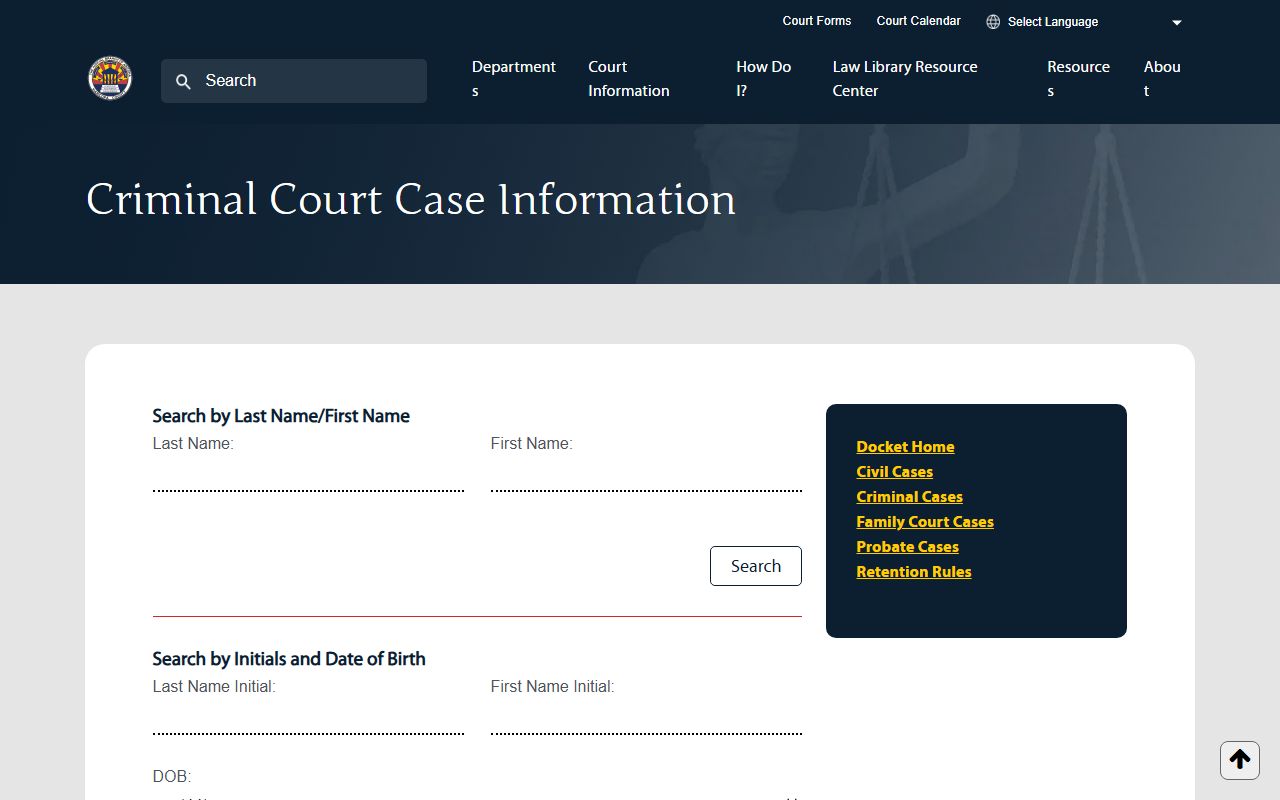
That same form returns a case list with the case number, party names, file date, and judicial officer for each match.
Criminal Case Search Fields
The Criminal Court Cases portal uses a small set of fields. Most are text inputs. The case-number search needs an exact match. The name search allows partial last names but works better when both name parts are full.
| Field Label | Type | Required | Notes / Format |
|---|---|---|---|
| Last Name | Text | Yes (name search) | Full last name preferred; partial allowed. |
| First Name | Text | No | Helps narrow common last names. |
| Initials | Text | Yes (initials search) | First and last initial, paired with DOB. |
| Date of Birth | Date | Yes (initials search) | MM/DD/YYYY format. |
| Case Number | Text | Yes (case search) | Format like CR2023-100000. |
The portal does not return downloadable documents. To pull the actual filings, request copies from the Clerk of the Superior Court through eAccess or the ECR Online viewer.
Arrest Records vs Conviction Records
An arrest record is made by the arresting agency. A conviction record is made by the court. The two records sit in different systems. They use different numbers. They are released under different rules. Mixing them up is the most common mistake when reading a Maricopa County criminal file.
| Arrest Record | Conviction Record | |
|---|---|---|
| Source | MCSO or local police | Superior Court or Justice Court |
| Created When | At booking | After guilty plea or verdict |
| Key Number | Booking number | Case number (CR prefix) |
| Contents | Mugshot, charges, booking date | Plea, sentence, restitution, probation |
| Public Access | Booking data via MCSO | Docket via Superior Court portal |
| Proof Standard | Probable cause | Beyond reasonable doubt |
A clean booking record does not always mean a clean court record. A person can be cited and released, then face a court summons later. Always cross-check the court docket.
Charges vs Convictions
Charges are the formal accusation. A conviction is the result. The gap between the two can run months or years. Many cases end in dismissal, diversion, or a reduced plea. The docket shows every step.
| Charge | Conviction | |
|---|---|---|
| Stage | Indictment or information | Verdict or guilty plea |
| Filed By | County Attorney or grand jury | Court enters judgment |
| Burden of Proof | Probable cause | Beyond reasonable doubt |
| Public Record | Yes, on the docket | Yes, in sentencing minute entry |
| Effect | Triggers court process | Triggers sentence and record |
Read the disposition line on the docket. It shows the actual outcome. A case that lists "dismissed" is not a conviction. A case that lists "guilty" with a sentence is.
What's in a Criminal Case Record
A Maricopa County criminal case file holds a set of standard fields. The docket lists each filing and event in date order. The case header shows the parties, the judge, and the location. Document copies are not always free online, but the docket itself is open.
- Case number with a CR prefix (e.g., CR2023-100000).
- Filing date and assigned judge or commissioner.
- Location, often "Downtown" or another court site.
- Party names, roles (Defendant, State of Arizona), and attorney.
- Docket entries with filing date, code, and a short description.
- Minute entries from each hearing, marked ME.
- Disposition line with verdict, plea, or dismissal.
Common docket codes include ORD for orders, ME for minute entries, NOH for notice of hearing, and MEJ for the minute entry of judgment. A "Pro Per" tag means the defendant is self-represented. An "Order Signed" entry shows a judge signed a ruling that day.
Note: Document copies usually need a Clerk request through eAccess or ECR Online, since the public docket lists entries but does not download them.
MCSO Booking and Mugshots
The Maricopa County Sheriff's Office runs the county jail system and processes every adult arrest in the county. All arrestees move through the Intake, Transfer and Release (ITR) facility first. Booking at ITR includes a search, health screening, mugshot photo, and fingerprints. Sheriff Jerry Sheridan leads the office. MCSO operates five active jail facilities plus ITR.
The booking record carries the booking number, name, date of birth, charge list, and custody status. Mugshots are part of the booking record. The MCSO inmate search at mcso.org/InmateInfo lets the public look up a person by booking number or by last name, first name, and date of birth (YYYYMMDD format). MCSO posts a disclaimer that the data should not be used for any legal action and that names can be falsified at booking, so true identity comes from prints.
Mugshots from official sources stay tied to the booking file. Old mugshots can follow a person online for years, even after a case is dismissed or sealed. That gap drives many sealing petitions.
For inmate custody status and visitation details, see the dedicated Maricopa County inmate records page.
Specialty Courts
Maricopa County Superior Court runs several specialty dockets. These programs target the reason behind the conduct, not just the conduct itself. Cases stay in the regular criminal system but get extra supervision, treatment, and review hearings. Completion can lead to reduced charges or dismissal.
Drug Court handles eligible felony drug offenses with a treatment focus. Mental Health Court pairs defendants with mental-health services and case managers. Veterans Court serves veterans whose offenses tie back to military service, including PTSD, substance use, or trauma. The Maricopa County Attorney's Office diversion program supports veteran defendants with that exact path in mind.
Each specialty docket has its own intake process, eligibility rules, and review schedule. The judge tracks progress at frequent status hearings. A defendant who completes the program can see major sentencing benefits.
- Drug Court for treatment-eligible felony drug cases.
- Mental Health Court for cases tied to mental-health diagnoses.
- Veterans Court for service-related offenses.
- DUI Court for repeat impaired-driving cases.
- Homeless Court for low-level offenses tied to housing instability.
Sealed vs Expunged Records
Arizona uses sealing more than true expungement. A.R.S. § 13-911 lets eligible people petition to seal arrest, conviction, and sentencing records after the waiting period runs. Marijuana expungement is its own track under A.R.S. § 36-2862. Setting aside a judgment under A.R.S. § 13-905 is a third, separate path that releases penalties but does not hide the record.
| Sealed (§ 13-911) | Marijuana Expungement (§ 36-2862) | |
|---|---|---|
| Reach | Most eligible offenses | Pre-legalization marijuana counts only |
| Effect on Record | Hidden from public view | Vacated and sealed; treated as cleared |
| Waiting Period | 10 / 5 / 3 / 2 years by class | None once eligible |
| Law Enforcement Access | Limited access | Very limited |
| Effective Date | Petition-based, court order | From July 12, 2021 forward |
Sealing wait times under A.R.S. § 13-911 run 10 years for class 2 and 3 felonies, 5 years for class 4, 5, and 6 felonies, 3 years for class 1 misdemeanors, and 2 years for class 2 and 3 misdemeanors. Certain offenses are not eligible, including serious violent and sex offenses.
The Arizona Judicial Branch self-service page on sealing records explains the petition steps in plain terms and lists eligibility tests.
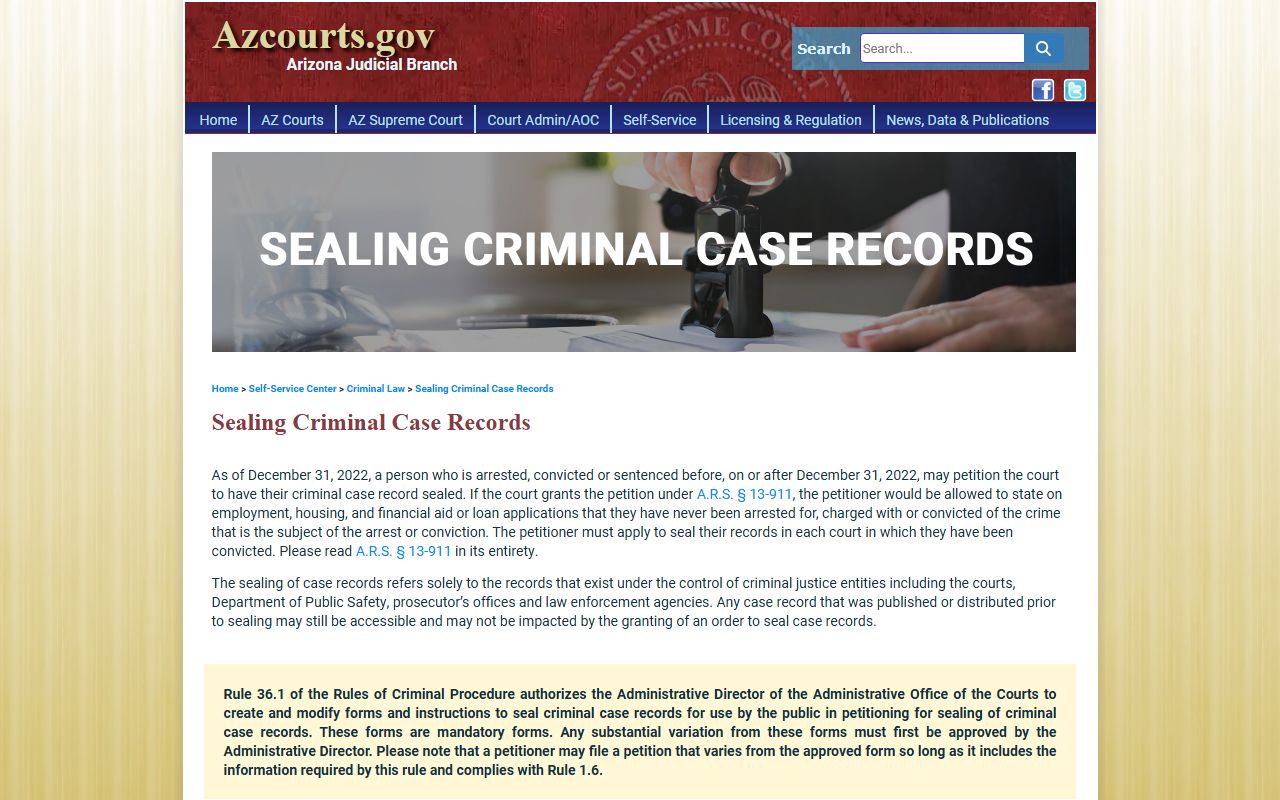
The self-service guide should be paired with the statute text when filing in Superior Court, since the court reviews each petition on the record.
Note: The full text of the sealing statute at A.R.S. § 13-911 sets the waiting periods and lists offense classes that stay off-limits.
The statute page on the Arizona Legislature site shows the full waiting-period chart and the ineligible offense list.
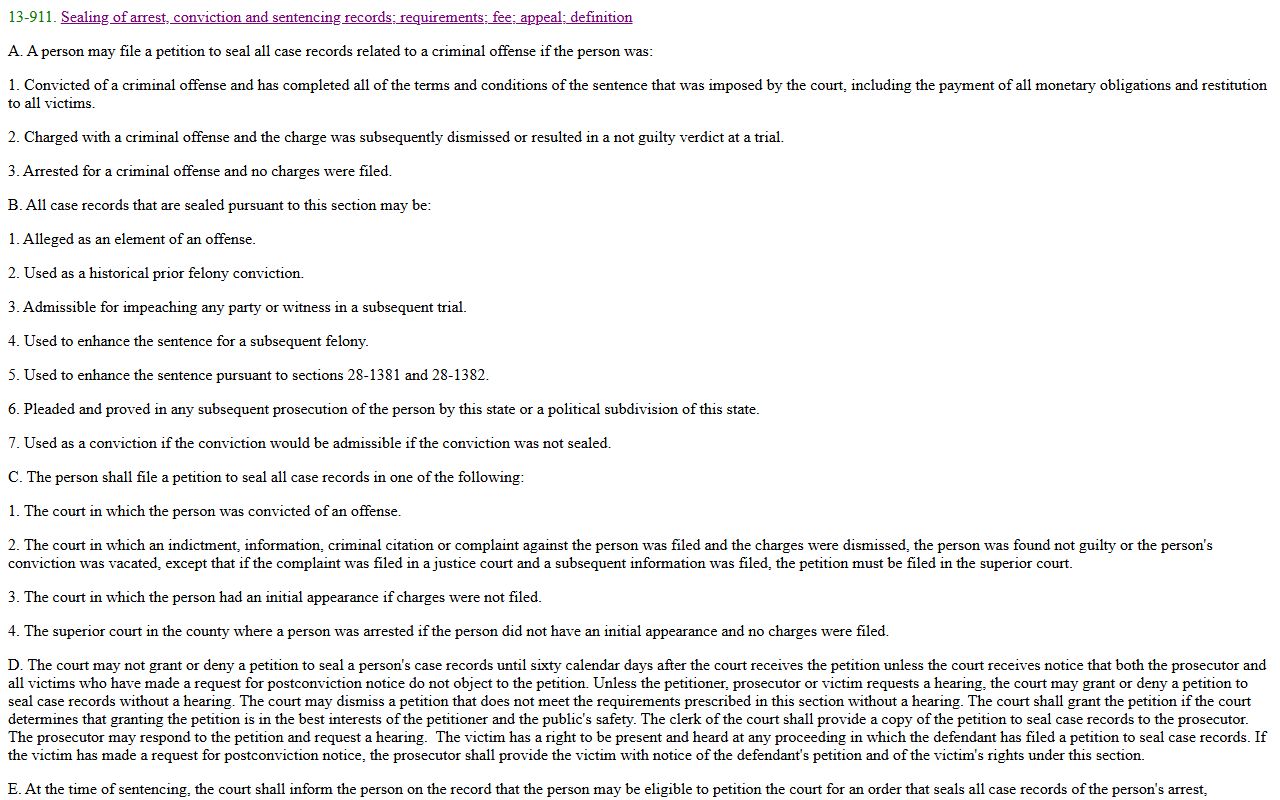
Read the statute before drafting a petition, because the eligibility rules turn on the conviction class and the time since sentence completion.
Juvenile Records
Juvenile records get much stronger protection than adult files. The Juvenile Department handles delinquency, dependency, adoptions, guardianship, and emancipation. Each category follows its own access rule. Some delinquency dockets are open to public inspection. Adoption, severance, and dependency files are not.
A.R.S. § 8-208 sets the framework. It allows public inspection of certain juvenile delinquency-related records while shielding adoption, severance, and dependency proceedings unless the law says otherwise. Victim identity is protected. Education records still fall under FERPA.
A.R.S. § 8-349 governs destruction of juvenile records. That is one reason older juvenile files may simply not be there to find. The Justice Courts and Superior Court do not surface juvenile delinquency records on the same public dockets used for adult cases.
Background Checks
A casual name lookup is not a background check. A real background check for employment, housing, or licensing must follow the federal Fair Credit Reporting Act and state rules. Statewide criminal history searches in Arizona go through the Arizona Department of Public Safety, not the county. DPS issues fingerprint-based criminal history reports for personal review and for many statutory uses.
County dockets and MCSO booking data are useful for spot checks. They do not return a certified criminal history. They also miss records held in other counties, in federal court, or in tribal courts. A full picture takes more than one source.
Employers and landlords who run background checks usually hire a third-party consumer reporting agency that handles dispute rights, adverse-action notices, and accuracy duties under federal law. A free public search does not meet those duties.
Important: This is not a consumer reporting agency under the FCRA and the information here may not be used for employment, tenant, credit, or insurance decisions.
Maricopa County Attorney's Office
The Maricopa County Attorney's Office (MCAO), led by Rachel Mitchell, prosecutes felony cases in Superior Court and represents county government. The office runs more than 900 full-time staff, including attorneys, investigators, paralegals, and victim advocates. Its mission covers prosecution, victim services, crime prevention, and county legal work.
MCAO's prosecution divisions split work by case type. The Investigations Division supports litigation across divisions. The Diversion Division offers alternatives to traditional prosecution for eligible defendants, including programs aimed at veterans with service-related trauma.
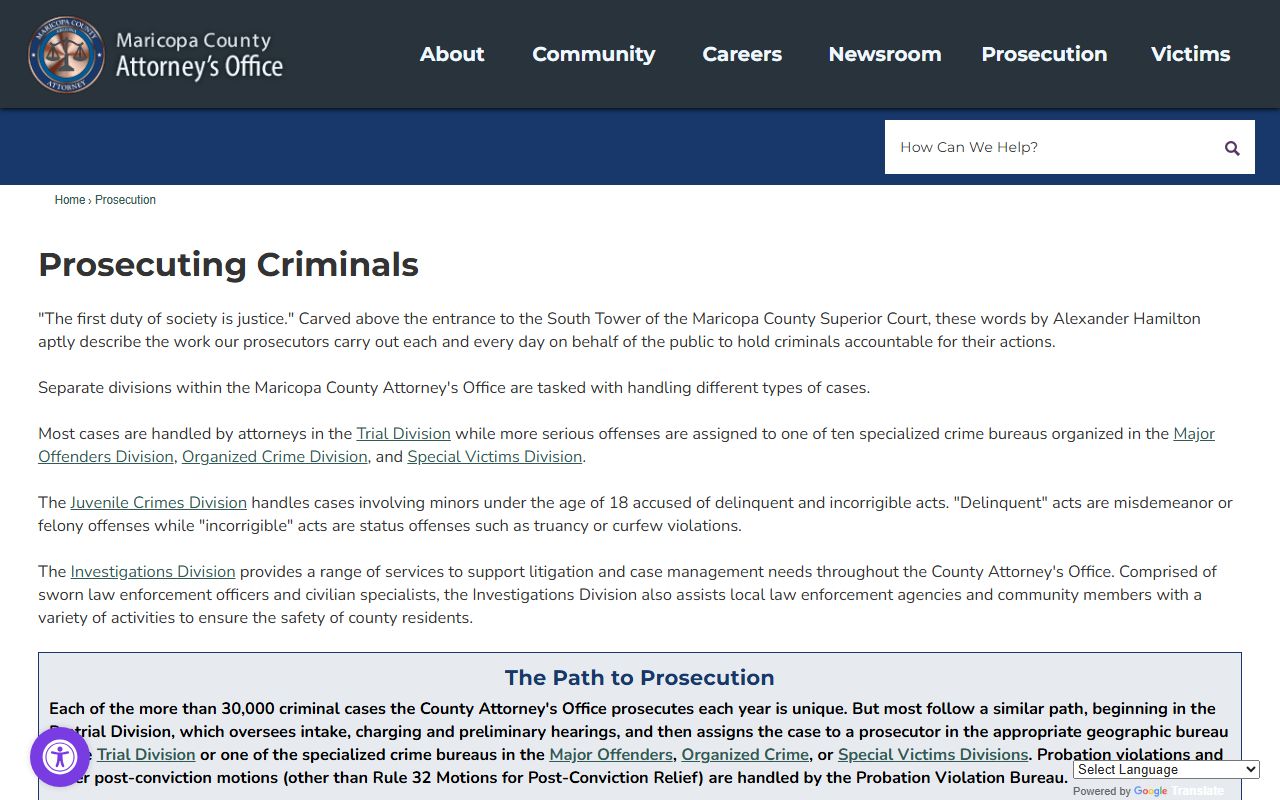
The MCAO Prosecution Division page gives an overview of the trial groups and the case types they handle.
The prosecution overview shows how the office splits charging, trial, and post-conviction work across teams.
Indigent defendants get court-appointed counsel through Maricopa County Public Defense Services. The umbrella office includes the Public Defender, Legal Defender, Legal Advocate, Public Advocate, and Contract Counsel teams, with assignment shifting if a conflict arises.
Restricted Criminal Records in Maricopa County
Most adult criminal dockets in Maricopa County are public. Several record types are not. Sealed cases under A.R.S. § 13-911 do not appear in the public docket once the order is entered. Grand jury materials, victim identifying data, certain images and video, and confidential presentence or probation reports stay restricted. Mental-health treatment records are confidential under A.R.S. § 36-509 even when a related docket entry is visible.
If a search hits a protected record, the result may show "Information is protected and will not be displayed." That is a feature of Rule 123 and the related statutes, not a portal error.