
Marriage License Application Overview
Every Maricopa County marriage license is issued by the Clerk of the Superior Court. The Clerk is Joseph W. Malka, the 12th person to hold the office. The license is a civil document, not a religious one, and the same form covers traditional, covenant, and covenant-conversion marriages. State law sets the rules for who must provide what on the application.
Arizona Revised Statutes section A.R.S. § 25-121 spells out the data points that go on every marriage license application. The statute drives the form fields used at the Clerk’s counter and in the online program. The license must be issued before the ceremony, signed at completion, and returned by the officiant for recording no later than 30 days after the ceremony. Once the officiant sends it back, the recorded license becomes a Maricopa County marriage record that any party can request a copy of.
People under the age of 16 cannot marry in Arizona. That rule took effect August 3, 2018. For minors aged 16 or 17 where state law allows, the Clerk needs an emancipation order or a notarized parental consent plus a birth certificate. Each license expires one year from the date of purchase.
Note: A Maricopa County marriage license is valid statewide, so a couple can marry in any Arizona county after the Clerk in Phoenix issues it.
How to Apply for a Marriage License
Applicants have two paths. They can walk in to one of four Clerk counters, or they can use the online marriage license program if at least one partner is an Arizona resident and the ceremony date is at least 30 days out. In-person service is faster. The Clerk hands the license to the couple the same day if the file is complete.
- Book an appointment online or plan to walk in at the Downtown Customer Service Center, Northeast Regional Court, Northwest Regional Court, or Southeast Court Center. Print and fill the application before the visit, or arrive early to fill it on site.
- Bring a valid government photo ID. Driver’s license, state ID card, passport, or military ID all work. Names must match the names on the application.
- Both parties sign the application in black ink in front of Clerk staff. Each party must confirm date of birth and, if they have one, Social Security number per A.R.S. § 25-121.
- Pay the marriage license fee. The Clerk takes cash, money order, debit card, or credit card. Personal checks are not accepted.
- Receive the license the same day. The couple may marry that day if an officiant is on hand. The officiant returns the signed license to the Clerk within 30 days of the ceremony.
For the online route, applicants upload front images of each photo ID, complete the affidavit, and wait 7 to 10 business days for Clerk review. After review, a Clerk calls from a restricted number between 8 AM and 5 PM weekdays to verify identity and run the credit card payment. The license then ships USPS First Class within three business days.
Marriage License Application Fields
The Clerk publishes the full application as a fillable PDF. The form is short, but every box has to be clear because the data prints straight onto the license. The field inventory below mirrors the current Clerk PDF for both traditional and covenant marriage licenses.
| Field | Type | Required | Notes |
|---|---|---|---|
| License type | Checkbox | Yes | Traditional, Covenant, or Covenant Conversion. |
| Non-refundable fee acknowledgement | Checkbox | Yes | Confirms all marriage license fees do not refund. |
| Applicant role | Checkbox | Yes | Bride, Groom, or Spouse for each party. |
| Full legal name | Text | Yes | First, middle, last. Black ink only. |
| Current residential address | Text | Yes | Street, city, state, ZIP for each applicant. |
| Social Security number | Text | Conditional | Required by A.R.S. § 25-121 if the applicant has one. Box to check if none. |
| Date of birth | Date | Yes | Both parties. |
| Age | Numeric | Yes | Both parties. |
| Contact address after marriage | Text | Yes | Name plus mailing address where the couple can be reached. |
| Email and phone | Text | Yes | Used for Clerk follow-up. |
| Pre-paid certified copy | Checkbox | Optional | Traditional raised-seal copy or e-certified copy. |
The SSN data is shared only with the Arizona Department of Economic Security for child-support enforcement. The Clerk does not release that number without written consent. If a person has an SSN and skips it on the form, that choice can disrupt other federal benefits later.
Marriage License Fees
The fees below come from the Clerk of the Superior Court fee schedule. The base price for a marriage license is set by state statute, and the Clerk adds small handling fees for mailed copies and online service. None of these fees refund once paid.
| Item | Amount |
|---|---|
| Marriage license (traditional or covenant) | $98.00 |
| Covenant conversion | $35.00 |
| Certified copy of recorded license (mailed, no SASE) | $43.50 |
| Certified copy with business-size SASE | $35.50 |
| Online marriage license postage and handling | $8.00 |
| Online pre-paid certified copy | $43.50 |
| E-certified marriage license | $35.00 |
| Certified copy or abstract at counter | $35.00 plus $0.50 per page |
Justice Court marriage license payment must be by money order only. The Clerk’s main locations take cash, debit, and credit. Visa, Mastercard, and American Express run on the online program.
Where Maricopa County Marriage Records Are Held
The Clerk keeps the official Maricopa County marriage record file. Once an officiant returns the signed license, Clerk staff record it and add it to the indexed marriage roll. From that point on, anyone can request a copy of the recorded license by paying the certified or e-certified copy fee. The Clerk lists four service counters across the Valley.
For most members of the public, the closest counter is the Downtown Customer Service Center at 601 W. Jackson Street in Phoenix. The Northeast, Northwest, and Southeast regional courts each offer the same marriage record copy service. None of these counters book appointments for deputized justice or municipal court locations, so applicants should plan to visit a Clerk site for the fastest turn.
For a side-by-side look at how the Clerk handles other case files, see the Clerk of Court page. For the wider request rules that cover any Superior Court file, see Maricopa County public records.
Clerk of the Superior Court in Maricopa County
Joseph W. Malka, Clerk
620 West Jackson Street
Phoenix, AZ 85003
602-372-5375 (602-37-CLERK)
Customer Service Center: 601 W. Jackson Street, Phoenix, AZ 85003
Northeast Regional Court: 18380 N. 40th Street, Phoenix, AZ 85032
Northwest Regional Court: 14264 W. Tierra Buena Lane, Surprise, AZ 85374
Southeast Court Complex: 222 E. Javelina Avenue, Mesa, AZ 85210
Hours: Monday-Friday, 8:00 AM-5:00 PM
Email: cocmlp@cosc.maricopa.gov
State Statute Behind the License
Marriage license data is set in statute. The Arizona Legislature posts the text of A.R.S. § 25-121 on its official site.
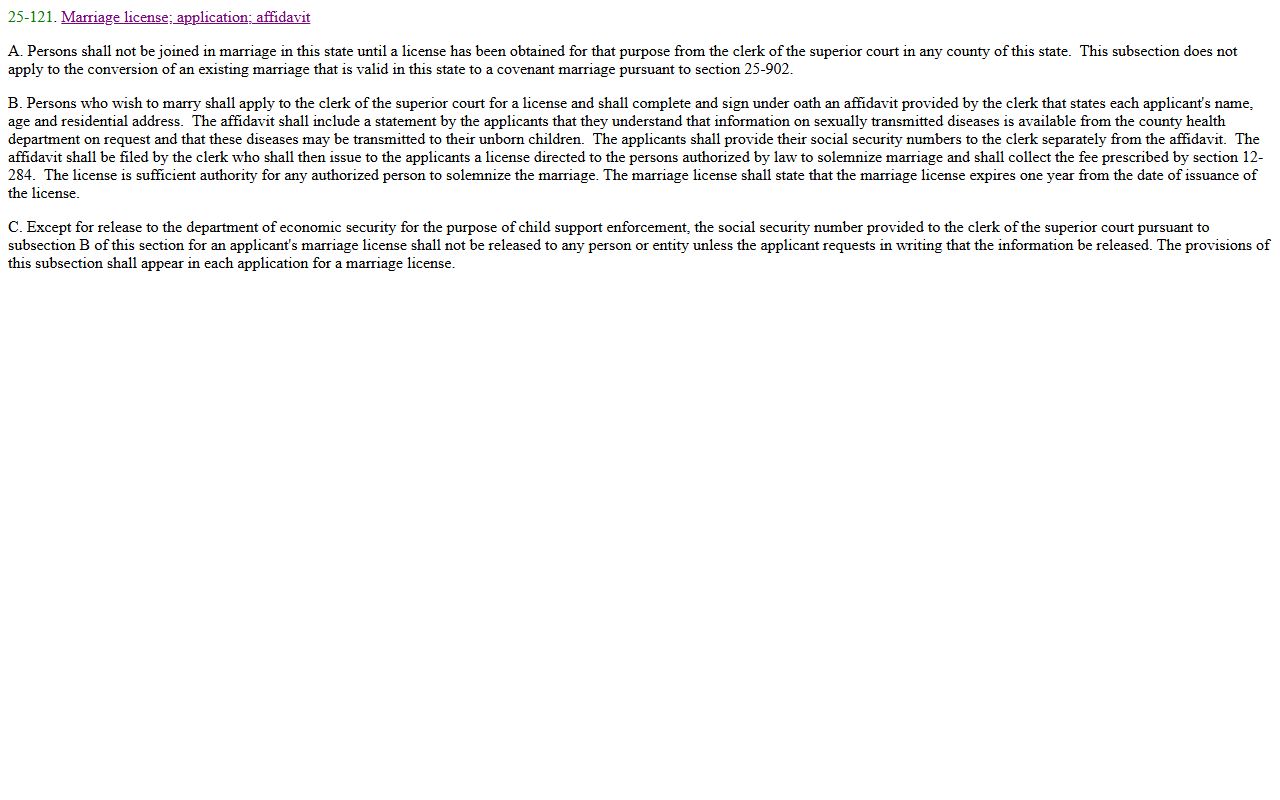
The statute lists every line that has to appear on a Maricopa County marriage license, which is why the Clerk’s form mirrors it word for word. Covenant marriage rules show up later in the same chapter at A.R.S. §§ 25-901 to 25-906, which took effect August 21, 1998. Couples picking covenant marriage must also turn in a notarized statement from a clergy member or counselor confirming premarital counseling and the receipt of the AOC covenant marriage pamphlet.
Divorce Records & Decrees
Divorce files live in the Superior Court Family Department. The Clerk’s office files the petition, the docket holds the case events, and the signed decree is stored in the Electronic Court Record at the close of the case. Family Department judges hear divorce, legal separation, child support, legal decision-making (custody), parenting time, and related family matters.
The Family Department posts a full overview on its site. See the Family Court department page for the list of services, judges, and self-help points of contact.
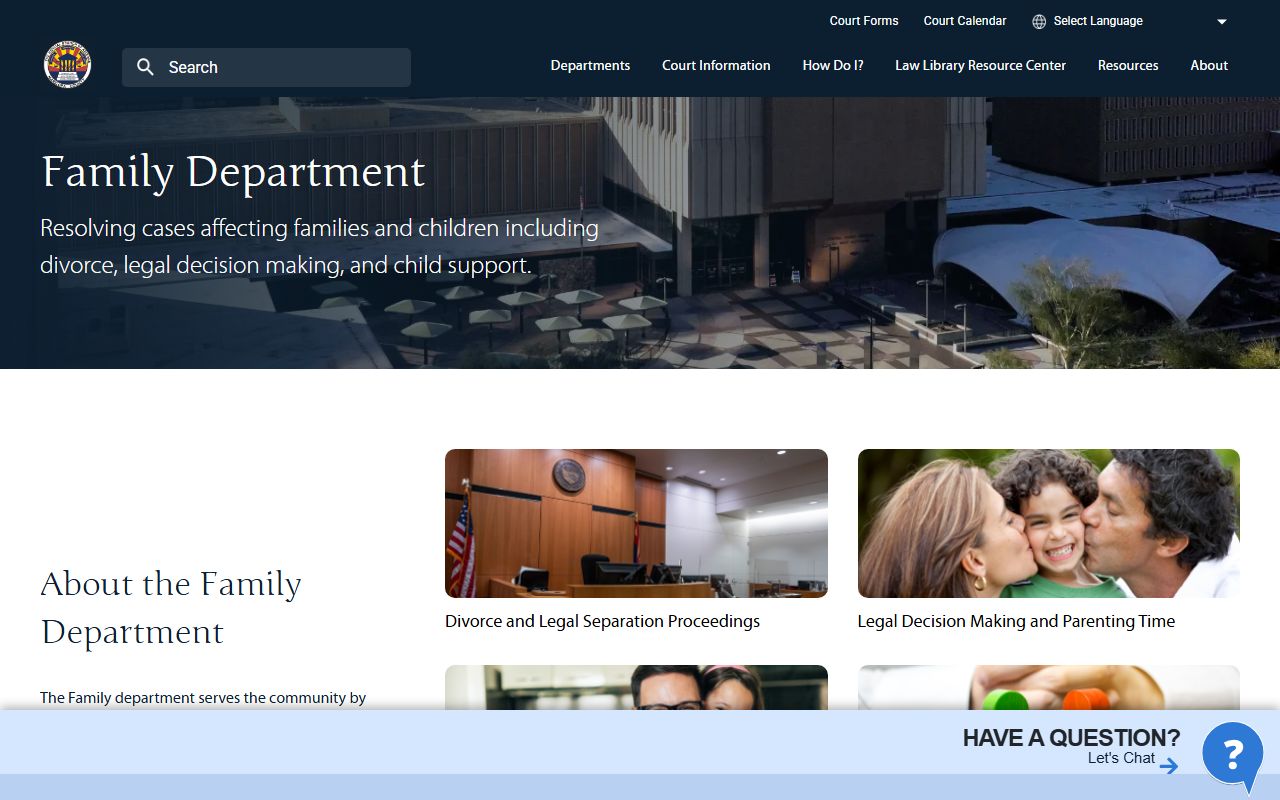
The page also points users to the Law Library Resource Center, which sells the divorce or legal separation packet that most self-represented parties use to file. Family case events appear in the Family Court Cases docket, and the signed decree itself can be requested in certified form from the Clerk.
To file for divorce, a party must meet Arizona residency and county venue rules. The basic path runs: complete the petition and summons from the Law Library packet, file with the Clerk and pay the filing fee (or apply for a deferral or waiver), serve the other party, wait for the response window, attend any ordered parent education or mediation, then submit a consent decree or proceed to trial.
Note: Arizona does not create common-law marriages within the state, but the Family Department may recognize a valid common-law marriage from a jurisdiction that does allow it.
How to Search Divorce Records
Family case docket data is free to view online. The Family Court Cases search portal lets the public look up a divorce or legal separation by last and first name or by case number. Docket entries show filings, motions, hearing dates, and the disposition.
The search lives on the Maricopa County Superior Court docket site. Start at the Family Court Cases case search form.
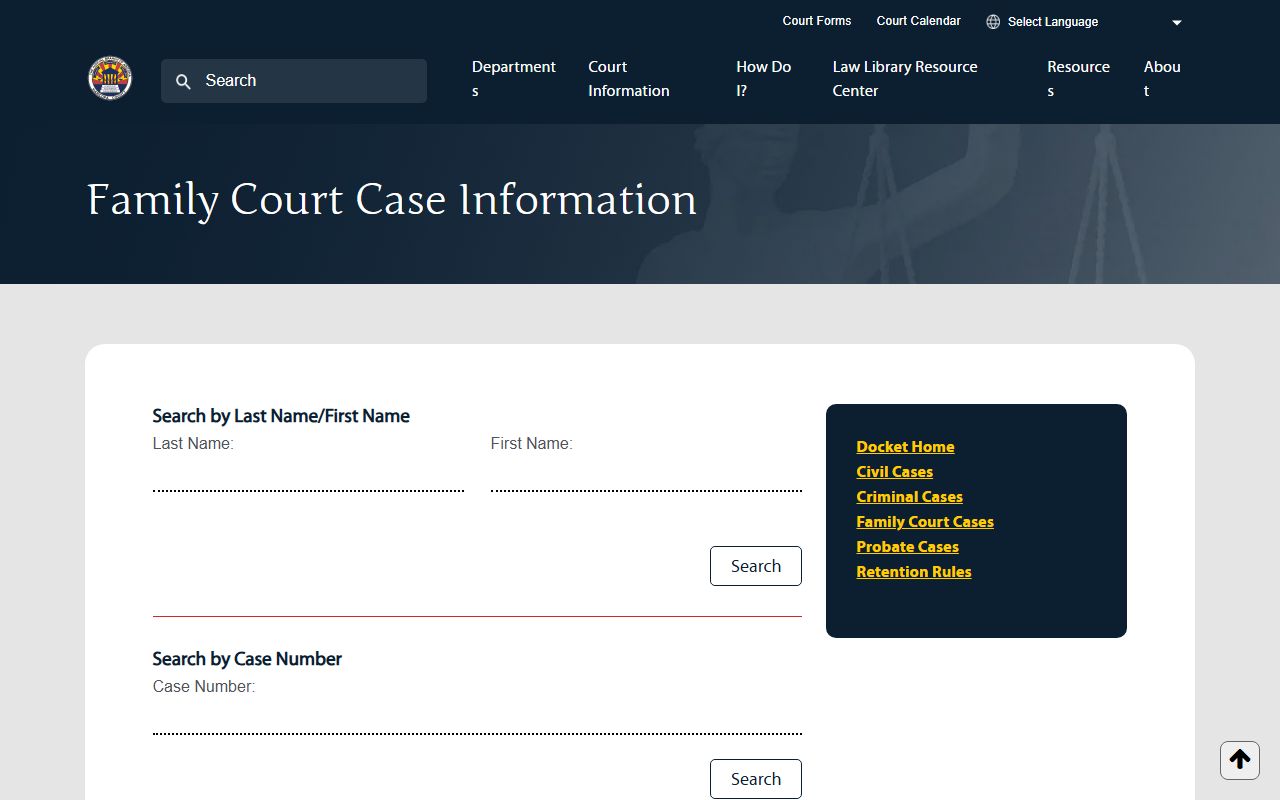
The portal returns case number, file date, party names, case type, and docket entries. It does not return PDF copies of the petition or decree. For those, a party or a member of the public must use the Clerk’s online records request form or visit a Clerk counter. For broader case-search tips that work on civil and criminal files too, the Maricopa County court records page covers the docket portals in more depth.
Certified Copies
Certified copies are the legal version of a Maricopa County marriage or divorce record. Banks, federal agencies, immigration counsel, and the Social Security Administration usually require them. A plain printout from the docket does not carry the Clerk’s seal and will not be accepted in most legal settings.
For a certified marriage license copy, the fee is $35.00 plus $0.50 per page at the counter, or $43.50 by mail without a return envelope. For a certified divorce decree, the request goes to the Clerk through the Online Records Request Form, with payment of the same per-page copy and certification fees from the Clerk schedule. The Clerk warns that e-certified copies are not accepted by the Social Security Administration, so couples planning a name change should ask for the traditional raised-seal copy.
State Vital Records
The Arizona Department of Health Services keeps statewide vital records for births and deaths, but it does not hold marriage or divorce files. Those stay at the county Clerk that issued or filed them. For a Maricopa County marriage license copy, the request always routes back to the Clerk of the Superior Court rather than the state office.
Arizona Department of Health Services - Bureau of Vital Records
1818 W. Adams Street
Phoenix, AZ 85007
602-364-1300
For marriage license verification across state lines, the state office can confirm that a license was issued in Arizona but will refer the requester to Maricopa County for the certified copy. Couples married in another county and now living in Maricopa County must still go back to the issuing county clerk for any certified marriage record from that file.
Restrictions on Records
Most Maricopa County marriage and divorce files are open to the public, but some pieces are sealed by statute or judge order. Social Security numbers on the marriage application are restricted by the Clerk and shared only with the Arizona Department of Economic Security for child support enforcement. The Clerk will not release that number without written consent from the applicant.
In divorce files, financial affidavits, child information sheets, and minor children’s data are often kept off the public docket. Judges may seal portions of a file involving domestic violence, custody evaluations, or mental health records. The docket entry will show the filing exists, but the document itself will not display in eAccess. Parties to the case can request access through their attorney or through a court order.
Juvenile family files (such as dependency or termination) sit outside the standard Family Court Cases docket and are not open to public search. Anyone looking for a record they cannot find by name should contact the Clerk through the Online Records Request Form or check the Maricopa County records FAQ for the next step.